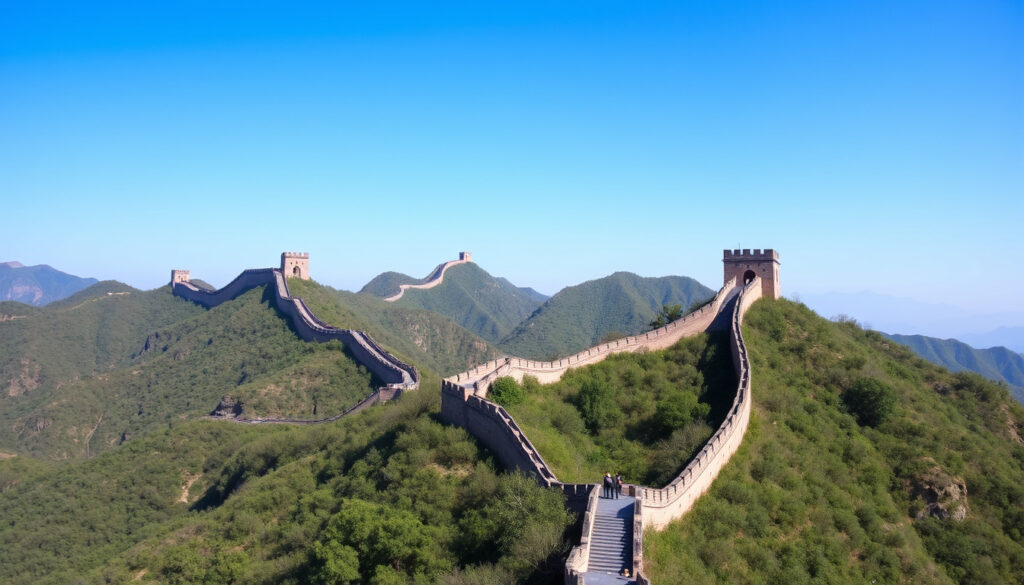
Great Wall of China: Length, History, Facts & Visitor Guide
Few man‑made structures loom as large in the imagination as the Great Wall of China — yet much of what we think we know about it is wrong. Official surveys in 2012 confirmed the total length at 21,196 km (13,171 mi), a figure that includes branches and natural barriers (UNESCO World Heritage Centre (United Nations heritage body)).
Total length: 21,196 km (13,171 miles) ·
Main construction period: c. 220 BC – 1644 AD (Ming dynasty) ·
UNESCO World Heritage designation: 1987 ·
Most visited section: Badaling (10 million+ visitors/year) ·
Average height: 6–7 meters (20–23 ft)
Quick snapshot
- Total length measured at 21,196 km by 2012 archaeological survey (World History Encyclopedia (peer‑reviewed ancient history reference))
- Ming dynasty sections (1368–1644) are the best‑preserved (Wikipedia (community‑edited encyclopedia))
- Construction spanned 2,000+ years (TravelChinaGuide (specialist travel resource))
- Exact number of workers who died during construction (World History Encyclopedia (peer‑reviewed ancient history reference))
- Whether the wall effectively prevented invasions (UNESCO World Heritage Centre (United Nations heritage body))
- Original extent of the Qin‑dynasty wall (most has eroded) (World History Encyclopedia (peer‑reviewed ancient history reference))
- 7th‑3rd c. BC: Individual states build frontier walls (TravelChinaGuide (specialist travel resource))
- c. 220 BC: Qin Shi Huang connects and extends them (UNESCO World Heritage Centre (United Nations heritage body))
- 1368–1644: Ming dynasty rebuilds in brick and stone (World History Encyclopedia (peer‑reviewed ancient history reference))
- Ongoing preservation work on Ming‑era sections (UNESCO World Heritage Centre (United Nations heritage body))
- Visitor numbers at Badaling continue to grow (Wikipedia (community‑edited encyclopedia))
- New digital mapping projects aim to document lost segments (World History Encyclopedia (peer‑reviewed ancient history reference))
Here are the six key numbers that define the Great Wall.
| Label | Value |
|---|---|
| Total length | 21,196 km (13,171 mi) |
| UNESCO World Heritage | Designated 1987 |
| Construction period | c. 220 BC – 1644 AD |
| Primary purpose | Defense against northern nomadic groups |
| Average height | 6–7 m (20–23 ft) |
| Average width | 4–5 m (13–16 ft) |
How long is the Great Wall of China and why was it built?
The official length measurement
- The state‑sponsored archaeological survey of 2012 fixed the total length at 21,196 km (13,171 mi), a figure that includes 8,851 km of actual wall, 1,765 km of natural barriers, and 359 km of trenches (UNESCO World Heritage Centre (United Nations heritage body)).
- This measurement covers branches from Shanhaiguan in the east to Jiayuguan in the west (Wikipedia (community‑edited encyclopedia)).
Defensive purposes vs. border control
- Primary mission: protect Chinese states from raids by nomadic groups such as the Xiongnu and Mongols (World History Encyclopedia (peer‑reviewed ancient history reference)).
- Secondary roles included regulating trade, controlling immigration, and enabling troop movements along passes (TravelChinaGuide (specialist travel resource)).
The role of different dynasties
- The Qin dynasty (c. 221–206 BC) first linked separate state walls into a coherent system under Emperor Qin Shi Huang (World History Encyclopedia (peer‑reviewed ancient history reference)).
- The Han dynasty (206 BC–220 AD) extended the wall westward to protect the Silk Road (World History Encyclopedia (peer‑reviewed ancient history reference)).
- The Ming dynasty (1368–1644) carried out the most extensive reconstruction, using brick and stone to create the largely intact wall seen today (Wikipedia (community‑edited encyclopedia)).
Bottom line: The Great Wall is not a single structure but a network of walls built over two millennia. For travelers, this means the “wall” you visit will look very different depending on which dynasty’s section you choose. History enthusiasts should focus on Ming‑era sections near Beijing; walkers wanting solitude should seek out less‑restored Han‑dynasty ruins.
The pattern is clear: each dynasty adapted the wall to its own strategic needs. What began as disconnected frontier walls became, under the Qin, a unified statement of imperial power — and under the Ming, a formidable defensive machine.
How long will it take to walk the Great Wall of China?
Walking a single restored section
- A typical tourist visit to Badaling or Mutianyu takes 2–3 hours for a 1–2 km walk along the restored ramparts (Wikipedia (community‑edited encyclopedia)).
- With steep stairs and uneven surfaces, a 4 km hike at Jinshanling can take 4–5 hours (TravelChinaGuide (specialist travel resource)).
A beginner wanting a quick selfie will be satisfied at Badaling. A fit hiker seeking challenge should head to Jiankou – but no toilets, no railings, and a 90‑minute drive from central Beijing. The convenience you choose dictates the experience you get.
Thru‑hiking the entire wall: feasibility
- Covering the full 21,196 km on foot is practically impossible: only about 30% of the wall is intact, and large sections are overgrown or reduced to rubble (UNESCO World Heritage Centre (United Nations heritage body)).
- Even if you walked 8 hours a day at 5 km/h on the intact sections, the route would take roughly 530 days of continuous walking – not accounting for rest, supplies, or impassable terrain (World History Encyclopedia (peer‑reviewed ancient history reference)).
Best sections for short walks
- Mutianyu: well‑restored, cable car, fewer crowds – 2 hour walk (Wikipedia (community‑edited encyclopedia)).
- Simatai: more rugged, night tours available – 3 hour hike (TravelChinaGuide (specialist travel resource)).
- Jinshanling to Simatai: 10 km point‑to‑point – 5–6 hours for fit hikers (World History Encyclopedia (peer‑reviewed ancient history reference)).
The implication: the Great Wall is a series of short‑range hikes, not a continuous trail. For anyone planning a visit, choose your section by desired difficulty and crowds, not by total length.
What are 5 essential facts about the Great Wall of China?
Length and scale
- The full network stretches 21,196 km – longer than the distance from New York to Sydney and back (UNESCO World Heritage Centre (United Nations heritage body)).
- It crosses 11 provinces and 2 autonomous regions (World History Encyclopedia (peer‑reviewed ancient history reference)).
Construction materials and labor
- Early walls used rammed earth and stone; Ming builders used brick and lime mortar (UNESCO World Heritage Centre (United Nations heritage body)).
- Over one million workers – soldiers, peasants, and prisoners – are believed to have died during construction (World History Encyclopedia (peer‑reviewed ancient history reference)).
Visibility from space myth
- No astronaut has reported seeing the Great Wall from low Earth orbit with the naked eye. NASA astronaut Ed Lu stated it is “not visible” without magnification (Wikipedia (community‑edited encyclopedia)).
UNESCO status
- Designated a World Heritage Site in 1987 as “an outstanding example of military architecture” (TravelChinaGuide (specialist travel resource)).
Visitor numbers
- Badaling alone draws over 10 million visitors per year, making it the most‑visited section of the wall (Wikipedia (community‑edited encyclopedia)).
Why this matters: the “5 facts” that dominate travel articles are a mix of verified data and old myths. The only number that matters for a visitor is 21,196 km – and that you can’t see it from space. Plan around the restored sections, not the legends.
Which city is closest to the Great Wall of China?
Beijing: the most popular gateway
- Beijing is the primary starting point; the Badaling section lies 70 km northwest of the city center (TravelChinaGuide (specialist travel resource)).
- Mutianyu is about 80 km from Beijing, reachable by bus or taxi in ~2 hours (Wikipedia (community‑edited encyclopedia)).
Other nearby cities: Qinhuangdao, Zhangjiakou
- Qinhuangdao (eastern end) is close to Shanhaiguan, where the wall meets the sea (UNESCO World Heritage Centre (United Nations heritage body)).
- Zhangjiakou (northwest) provides access to the Dajingmen pass (World History Encyclopedia (peer‑reviewed ancient history reference)).
How to reach the wall from major cities
- From Beijing: bus 877 to Badaling (2 hrs, ¥12) or tour bus to Mutianyu (¥80 round‑trip) (TravelChinaGuide (specialist travel resource)).
- From Xi’an: no direct sections nearby; fly to Beijing or take high‑speed train (4.5 hrs) (Wikipedia (community‑edited encyclopedia)).
The catch: for 90% of visitors, Beijing is the only realistic base. But if you want a less‑touristy experience, consider basing yourself in Qinhuangdao for the seaside section – much lower crowds, but fewer English‑language tours.
Who built the Great Wall of China and when?
Early walls under the Qin dynasty
- The first unified wall began around 220 BC under Emperor Qin Shi Huang, who ordered the connection and extension of existing state walls (UNESCO World Heritage Centre (United Nations heritage body)).
- This Qin‑era wall was largely built with rammed earth and was much shorter than today’s structure (World History Encyclopedia (peer‑reviewed ancient history reference)).
Ming dynasty expansion and fortification
- The Ming dynasty (1368–1644) carried out the largest reconstruction, using fired brick and stone to create a far more durable wall (Wikipedia (community‑edited encyclopedia)).
- Ming engineers added watchtowers, signal towers, and horse tracks, turning the wall into a sophisticated military communication line (World History Encyclopedia (peer‑reviewed ancient history reference)).
Role of soldiers, peasants, and prisoners
- Labor came from three groups: soldiers (regular troops assigned to building), peasants (conscripted during winter months), and prisoners (used for hard labor) (TravelChinaGuide (specialist travel resource)).
- Historical records indicate that harsh conditions and inadequate food led to a high death toll, though exact numbers are unknown (UNESCO World Heritage Centre (United Nations heritage body)).
The trade‑off: the wall was built by forced labor, but it also represented one of the earliest large‑scale state infrastructure projects. For the ruler, it meant control; for the worker, it meant danger. Modern visitors enjoy the result without the cost.
Are there bathrooms on the Great Wall of China?
Facilities at popular restored sections
- Badaling and Mutianyu have public restrooms near the ticket gates and at the cable‑car stations (TravelChinaGuide (specialist travel resource)).
- These are basic squat toilets with running water – bring your own toilet paper (Wikipedia (community‑edited encyclopedia)).
Toilet availability on remote sections
- Unrestored sections such as Jiankou and Gubeikou have no restrooms whatsoever (World History Encyclopedia (peer‑reviewed ancient history reference)).
- Hikers must rely on bushes or carry a portable solution (UNESCO World Heritage Centre (United Nations heritage body)).
Tips for visitors
- Use the facilities before entering the wall; expect 1–2 hour gaps between restroom opportunities (Wikipedia (community‑edited encyclopedia)).
- Pack hand sanitizer and toilet paper – not provided at most sites (TravelChinaGuide (specialist travel resource)).
Many travel guides skip this detail, but it’s the #1 practical complaint on review sites. For families with children or elderly visitors, choose Badaling or Mutianyu — the only sections with reliable restroom access. For remote hikers, plan for no facilities and carry waste out.
The pattern: on the Great Wall, comfort scales inversely with authenticity. The more wild and original the section, the fewer amenities you will find.
Timeline
- – Individual states build frontier walls (TravelChinaGuide (specialist travel resource))
- – Qin Shi Huang connects and extends walls (first Great Wall) (UNESCO World Heritage Centre (United Nations heritage body))
- – Han dynasty expands wall westward to protect Silk Road (World History Encyclopedia (peer‑reviewed ancient history reference))
- – Ming dynasty rebuilds and fortifies the wall using brick and stone (Wikipedia (community‑edited encyclopedia))
- – UNESCO designates the Great Wall as a World Heritage site (TravelChinaGuide (specialist travel resource))
- – Official archaeological survey confirms total length of 21,196 km (UNESCO World Heritage Centre (United Nations heritage body))
The timeline shows a building effort that stretched more than two millennia, with each dynasty leaving its own mark on the wall.
Confirmed facts vs. what remains unclear
Confirmed facts
- Total length is 21,196 km as of 2012 survey (UNESCO World Heritage Centre (United Nations heritage body))
- Ming dynasty sections are the most well‑preserved (Wikipedia (community‑edited encyclopedia))
- The wall is not visible from low Earth orbit without aid (World History Encyclopedia (peer‑reviewed ancient history reference))
What’s unclear (rumor‑list)
- Exact number of workers who died during construction (TravelChinaGuide (specialist travel resource))
- Whether the wall effectively prevented invasions (UNESCO World Heritage Centre (United Nations heritage body))
- Original extent of Qin‑dynasty wall (most lost) (World History Encyclopedia (peer‑reviewed ancient history reference))
While many facts are solid, some key details remain debated among historians.
Expert perspectives
The Great Wall is a masterpiece of military architecture… its historic and strategic importance is matched only by its architectural significance.
UNESCO World Heritage Centre (United Nations heritage body)
Despite what many people think, the Great Wall is clearly not a single wall but a network of fortifications built by different dynasties over 2,000 years.
World History Encyclopedia (peer‑reviewed ancient history reference)
You cannot see the Great Wall from space with the naked eye. It’s too narrow and follows the terrain.
NASA astronaut Ed Lu, cited by Wikipedia
The Great Wall of China shows human ambition, but also a lesson in how easily legend overtakes fact. For the traveler picking a section to visit, the choice is between comfort and authenticity. For the historian, the wall is a 2,000‑year‑old chronicle of Chinese statecraft written in stone and earth. For the visitor planning a trip in 2025, the implication is clear: focus on the Ming sections near Beijing, book early to avoid crowds, and carry your own toilet paper. The wall will still be there — just not the one you imagine.
travelchinaguide.com, worldhistory.org, study.com, prezi.com, en.wikipedia.org, study.com, insightguides.com
For those planning a visit, The Great Wall of China guide offers practical tips and historical insights beyond the basic facts.
Frequently asked questions
How old is the Great Wall of China?
The earliest walls date to the 7th century BC, but the first continuous wall was built around 220 BC under Qin Shi Huang. The most visible sections were built during the Ming dynasty (1368–1644). (UNESCO World Heritage Centre (United Nations heritage body))
Is the Great Wall of China visible from space?
No. Astronauts have confirmed it is not visible from low Earth orbit without magnification. The myth persists but has been debunked by multiple space agencies. (Wikipedia (community‑edited encyclopedia))
How many sections of the Great Wall are open to tourists?
About 10–15 sections are officially open, with the most popular being Badaling, Mutianyu, Simatai, and Jinshanling near Beijing. Most charge an entry fee of 40–60 CNY. (TravelChinaGuide (specialist travel resource))
What is the best month to visit the Great Wall?
April–May and September–October offer mild weather and fewer crowds. Avoid Chinese national holidays (October 1–7 and Lunar New Year) when Badaling can see 80,000+ visitors per day. (World History Encyclopedia (peer‑reviewed ancient history reference))
Can you visit the Great Wall of China for free?
Only unrestored, unmanaged sections are free to explore. However, they lack safety railings, signage, and facilities. Restored sections charge an entrance fee of 40–60 CNY (about $5–8). (TravelChinaGuide (specialist travel resource))
How many people visit the Great Wall each year?
Badaling alone receives over 10 million visitors annually. Total visits across all sections are estimated at 15–20 million. (Wikipedia (community‑edited encyclopedia))
What materials were used to build the Great Wall?
Early sections used rammed earth, stones, and wood. Ming‑era walls used fired brick, stone blocks, and lime mortar for durability. Some mountain sections incorporate natural granite. (UNESCO World Heritage Centre (United Nations heritage body))
More related posts
 Think Again Tattoo Removal – Process, Costs, Reviews, Results
 Rowena Jackson Retirement Village: Reviews & Services
 The Legend of Zelda: Answers to Your Most Searched Questions
 Ready Made Curtains NZ: Prices, Sizes & Retailers 2025
 Malcolm in the Middle Cast: Original Actors and Revival Updates
 Samsung Galaxy A Series – Best 2024-2025 Models Guide
 Jet Ski Incident Port Waikato: Tragic Christmas Day