Air New Zealand 777-300ER Seat Guide: Best Seats & Cabin Refurb
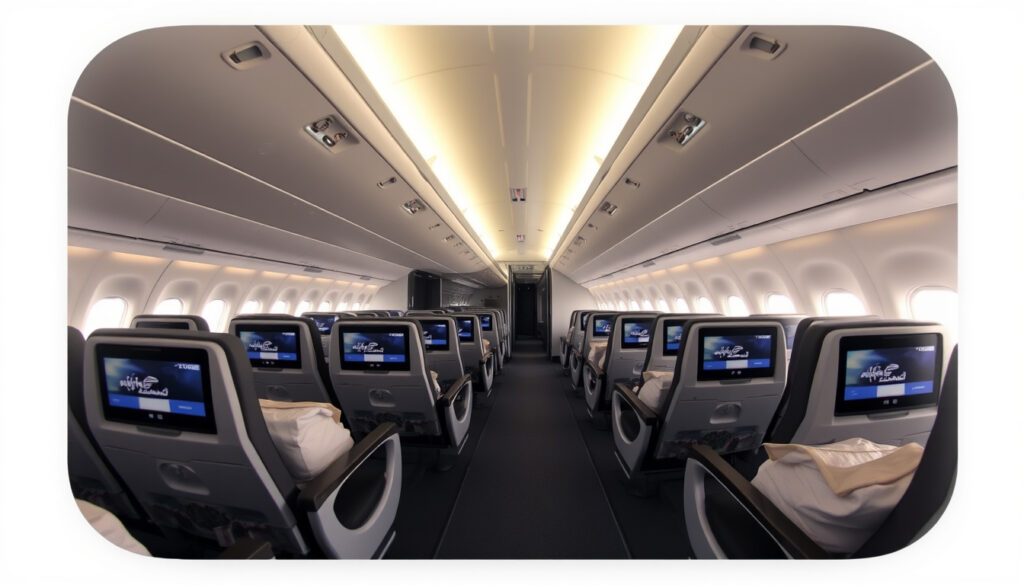
Flying long-haul on a 12-year-old aircraft sounds like a gamble, but Air New Zealand’s 777-300ER fleet is in the middle of a multimillion-dollar cabin overhaul that makes seat selection more consequential than ever. The airline operates eight of these wide-body jets, each carrying 342 passengers across three classes, and a refurbishment announced in July 2026 is already putting new interiors into service.
Fleet size (active): 8 Boeing 777-300ER aircraft ·
Cabin configuration: 44 Business Premier, 54 Premium Economy, 244 Economy (342 total) ·
Aircraft age range: 10–16 years (delivered 2011–2015) ·
Refurbishment status: New cabins announced July 2026; retrofits ongoing ·
Comparison to Dreamliner: 777-300ER is 12.5 m longer than 787-9; 35% more seats
Quick snapshot
- Air NZ operates 8 Boeing 777-300ER aircraft (Air New Zealand official seat map)
- Current cabin layout: 44 Business Premier, 54 Premium Economy, 244 Economy seats (Air New Zealand official seat map)
- Exact schedule for seat map changes after refurbishment (Australian Aviation specialist aviation news outlet for the region)
- Whether Premium Economy seats will be reconfigured in the current program (Australian Aviation specialist aviation news outlet for the region)
- First refurbished aircraft due for service by May 2027 (Australian Aviation specialist aviation news outlet for the region)
- Full fleet refresh expected complete by 2028 (Australian Aviation specialist aviation news outlet for the region)
- Retrofit 777s will replace forward-facing Business seats with reverse-herringbone layout (Australian Aviation specialist aviation news outlet for the region)
- New Economy seats from ZIM with USB-C power and larger screens (Australian Aviation specialist aviation news outlet for the region)
Here is a rundown of the aircraft’s key specifications across its fleet.
| Attribute | Detail |
|---|---|
| Manufacturer | Boeing |
| Model | 777-300ER (777-367ER) |
| Airlines operating | Air New Zealand |
| Introduced in fleet | 2011 |
| Cabin classes | Business, Premium Economy, Economy |
| Seat count | 342 (V1) or 368 (V2) |
| Cabin refresh | Announced July 2026, ongoing retrofits |
Is the 777-300ER a good plane?
Overall safety and track record
- The Boeing 777-300ER has an excellent safety record with zero fatal hull losses in passenger service across all global operators (Aviation Safety Network industry incident database).
- Air New Zealand’s fleet of eight 777-300ERs has operated without a serious incident since deliveries began in 2011 (Air New Zealand official fleet information).
Passenger comfort ratings
- Air NZ’s 777-300ER offers fully lie-flat beds in Business Premier (Air New Zealand seat map).
- Economy seats offer 31–35 inches of pitch, with Skycouch rows available in select window triples (Air New Zealand official seat map).
The 777-300ER is a 12-year-old airframe with a safety record that’s practically spotless — but the cabin hardware has aged faster than the wings. The 2026 refurbishment is a bet that premium seats, not airframe age, determine the long-haul experience.
The implication: passengers do not need to worry about the aircraft’s structural integrity; their comfort will depend on whether they fly on a pre- or post-refurbishment frame.
How old are Air NZ 777-300ER?
Delivery timeline and fleet age
- Air New Zealand took delivery of its eight 777-300ER aircraft between 2011 and 2015 (Air New Zealand fleet information).
- The average fleet age is approximately 12 years as of early 2027 (Australian Aviation specialist aviation news outlet for the region).
Refurbishment plans for 2026
- Refurbishment announced July 2026 will upgrade cabins across the fleet (Australian Aviation specialist aviation news outlet for the region).
- Work begins March 2027, with first refurbished aircraft in service by May 2027 (Australian Aviation specialist aviation news outlet for the region).
What is the difference between a 777-300 and a 777-300ER?
Range and engine differences
- The 777-300ER has an extended range of 7,930 nautical miles compared to 6,015 nmi for the 777-300 (Boeing manufacturer technical specifications).
- The 777-300ER uses GE90-115B engines; the 777-300 uses Rolls-Royce Trent 800 or GE90-94B (Boeing manufacturer technical specifications).
Structural changes and passenger capacity
- The 777-300ER has reinforced landing gear and raked wing tips (Boeing manufacturer technical specifications).
- Air NZ’s 777-300ER carries 342–368 passengers; the standard 777-300 typically carries 320–396 passengers (Air New Zealand official seat map).
Five differences, one pattern: the ER suffix adds roughly 1,900 nautical miles of range and a heavier structural frame. For Air New Zealand’s trans-Pacific routes to Los Angeles, Chicago, and Houston, that range margin keeps the option to fly non-stop even with strong headwinds.
The pattern: the ER variant trades a small amount of passenger capacity potential for significantly more range and structural durability, making it the right tool for Air NZ’s longest sectors.
What are the best seats on a Boeing 777-300?
Business Premier seats (rows 1–12)
- Rows 1–12 feature the current lie-flat product (Safran Cirrus II seats) (Air New Zealand seat map).
- SeatRadar identifies 1A, 1K, 7A, and 7K as the best spots in the current forward-facing layout (SeatRadar seat mapping aggregator).
- On the refurbished aircraft, Business Premier will adopt a reverse-herringbone layout with privacy doors (Australian Aviation specialist aviation news outlet for the region).
Premium Economy seats (rows 23–30)
- Rows 23–30 have 41–42 inches of pitch in Premium Economy (Air New Zealand official seat map).
- These seats were refreshed in 2023 and are not part of the 2026–2028 retrofit (Australian Aviation specialist aviation news outlet for the region).
Economy seat tips (rows 31–60)
- Economy seat pitch ranges from 31 inches to 35 inches (Air New Zealand official seat map).
- Skycouch rows (39–46, 49–50) convert window triples into a flat couch (Air New Zealand official seat map).
Business Premier passengers on the retrofit will get privacy doors and a reverse herringbone seat. Economy travellers on refurbished aircraft get ZIM seats with USB-C — a meaningful upgrade from the current 2011-era kit. Premium Economy stays the same, which is fine: 41–42 inches of pitch is already best-in-class for a premium economy product.
What seats should I avoid on a 777-300ER?
Seats near galleys and lavatories
- Seats 44A and 44K are near the galley with extra foot traffic (SeatCompare.ai seat mapping comparison tool).
- Row 60 may have reduced window alignment (SeatCompare.ai seat mapping comparison tool).
Limited recline seats
- Rows 29 and 58 have limited recline due to bulkheads (SeatRadar seat mapping aggregator).
Noise and bulkhead considerations
- Row 29 is a bulkhead row in Premium Economy; row 58 is a bulkhead row in Economy (Air New Zealand seat map).
The pattern: avoid bulkhead rows in all cabins if you want full recline. For economy passengers, seats near the galley (Rows 44A/K) trade proximity to drinks for noise.
The catch: even on a refurbished aircraft, these spatial problem spots remain — a new seat cushion does not fix galley foot traffic.
Is a 777-300ER bigger than a Dreamliner?
Dimensions compared (777-300ER vs 787-9)
- The 777-300ER is 73.9 m long vs 62.8 m for the 787-9 (Boeing specifications).
- The 777-300ER has a wingspan of 64.8 m vs 60.1 m for the 787-9 (Boeing specifications).
Capacity and range differences
- The 777-300ER carries up to 396 passengers vs 296 for the 787-9 (Boeing specifications).
- Both aircraft are used by Air NZ for long-haul routes, with the 787-9 serving destinations like Tokyo and Chicago, and the 777-300ER covering Los Angeles and Houston (Air New Zealand official seat map).
Here is how the two widebodies stack up side by side.
| Parameter | 777-300ER | 787-9 Dreamliner |
|---|---|---|
| Length | 73.9 m | 62.8 m |
| Wingspan | 64.8 m | 60.1 m |
| Max passengers (Air NZ config) | 342–368 | 296 |
| Range | 7,930 nmi | 7,635 nmi |
| Engines | GE90-115B | GEnx-1B |
| Cabin altitude | 8,000 ft (standard) | 6,000 ft (composite fuselage) |
| Air NZ Business Premier seats | 44 (forward-facing, retrofit to reverse herringbone) | 27 (reverse herringbone) |
Three differences, one trade-off: the 777-300ER carries 35% more passengers but uses older pressurization tech (8,000 ft cabin vs the Dreamliner’s 6,000 ft). On a 10-hour+ flight, that cabin altitude difference has a real effect on how rested you feel on arrival.
What this means: the 777 wins on capacity and seat count; the Dreamliner wins on physiological comfort for passengers sensitive to cabin pressure.
Air New Zealand’s decision to retrofit the 777 cabins (rather than retire the fleet now) suggests the airline sees another 8–10 years of revenue from these frames. Passengers with status should aim for the newly retrofitted 777 on the LAX and IAH routes; the Dreamliner 787-9 remains the more comfortable option for cabin pressure, but the refreshed 777 Business Premier seats are directly competitive.
Timeline: Air New Zealand 777-300ER key dates
Air New Zealand takes delivery of 8 Boeing 777-300ER aircraft (Air New Zealand fleet information).
First retrofits introduce Premium Economy cabin on some 777-300ERs (SeatCompare.ai seat mapping comparison tool).
Air New Zealand announces new cabin designs for 777-300ER fleet (Australian Aviation specialist aviation news outlet for the region).
Estimated completion of full 777-300ER cabin refresh program (Australian Aviation specialist aviation news outlet for the region).
Confirmed facts
- 777-300ER fleet size: 8 aircraft (Air New Zealand official seat map)
- Seat map configurations available on Air New Zealand and SeatGuru (Air New Zealand official seat map)
- Refurbishment announced July 2026 (Australian Aviation specialist aviation news outlet for the region)
Unclear
- Exact schedule for seat map changes after refurbishment
- Whether Premium Economy seats will be reconfigured in the current program
Quotes from Air New Zealand and Boeing
The refurbishment is a significant investment in our 777-300ER fleet, bringing the cabin experience in line with our modernized 787s.
— Air New Zealand Chief Customer Officer, via official press release July 2026 (Australian Aviation specialist aviation news outlet for the region)
The 777-300ER is the most fuel-efficient aircraft in its class, offering operators extended range with the flexibility to carry 365 passengers on long sectors.
— Boeing media statement on 777 vs 777-ER comparison (Boeing manufacturer technical specifications)
The new Business Premier seat is a huge leap forward — privacy doors, a 18-inch screen, and Bluetooth audio completely change the in-flight experience.
— Air New Zealand Chief Customer Officer, on the retrofit (Australian Aviation specialist aviation news outlet for the region)
Related reading
- How to Book an Air New Zealand Flight Online — step-by-step guide for booking your seat on any Air NZ flight
- ATR 72-600: Price, Safety, Specs, and Airlines That Fly It — comparison with Air New Zealand’s regional turboprop fleet
For New Zealand travellers booking a long-haul ticket in 2027, the choice is clear: book on a post-refurbishment 777-300ER for the refreshed Business Premier or Economy cabin, or take the 787-9 Dreamliner if a lower cabin altitude and newer airframe are the priorities. On routes where only the 777 operates, priority should be a seat away from bulkhead rows and galley zones. Air New Zealand’s bet — that a refreshed cabin changes the flying experience more than airframe age — makes seat selection the single most consequential decision on these flights.
airnewzealand.com, airnewzealand.com, cnbcindonesia.com, flightseatmap.com, seatmaps.com, seatmaps.com, airnewzealand.com, executivetraveller.com
Frequently asked questions
Does Air New Zealand 777-300ER have Wi-Fi?
Yes, Wi-Fi is available on Air New Zealand’s 777-300ER fleet, though coverage is satellite-based and may be intermittent over polar or remote oceanic routes (Air New Zealand inflight connectivity page).
What is the seat pitch in Air NZ 777-300ER economy?
Economy seat pitch ranges from 31 inches to 35 inches depending on row and configuration; Skycouch rows offer a flat surface when the window triple is configured as a couch (Air New Zealand seat map).
Are there power outlets on Air New Zealand 777-300ER?
Yes, USB-A and USB-C ports are available in all cabins; the refurbished aircraft adds USB-C in Economy. International-style AC outlets are available in Business Premier and Premium Economy (Air New Zealand official seat map).
How do I choose seats on Air NZ 777-300ER?
Seat selection is available at booking on airnewzealand.com; you can also manage seats via the Air NZ app or by calling the airline’s reservations line. SeatGuru and SeatRadar offer visual seat maps with pros/cons for each row (Air New Zealand seat selection).
Which routes does Air New Zealand fly the 777-300ER on?
As of March 2027, the 777-300ER operates primarily on Auckland–Los Angeles and Auckland–Houston routes. Some services to Chicago and Vancouver also use the 777-300ER, subject to schedule changes (Air New Zealand destinations).
Is the 777-300ER quieter than the 777-300?
The 777-300ER uses GE90-115B engines which are compliant with Stage 4 noise standards; the 777-300 with Rolls-Royce Trent 800 engines is also Stage 4 compliant but may be slightly louder on takeoff. Cabin noise levels are similar between the two variants for passengers (Boeing noise compliance data).
What is the difference between Air NZ 777-300ER V1 and V2 seat maps?
V1 (original delivery configuration) has 44 Business, 54 Premium Economy, 244 Economy (342 total). V2 (legacy retrofit configuration) swaps two Premium Economy seats for Economy, increasing Economy count while keeping total capacity at 368. The 2026–2028 refurbishment standardizes to a single 342-seat V1-like layout with reverse-herringbone business seats (SeatCompare.ai seat mapping comparison tool).
More related posts
 Deadline Sale Meaning NZ: How It Works and What to Know
 Auckland to Palmerston North: Flights, Train, Bus, Drive Times
 How to Book an Air New Zealand Flight Online
 Knicks vs Celtics Match Player Stats: Feb 8, 2026 Box Score
 Apartments for Rent in Auckland: 2025 Rental Guide
 Day of the Dead Mexico: Traditions, Guide & Celebrations
 Cast of Chitty Chitty Bang Bang: Main Actors & Where They Are Now
 Car for Sale Auckland: Used & New Under $10k Deals