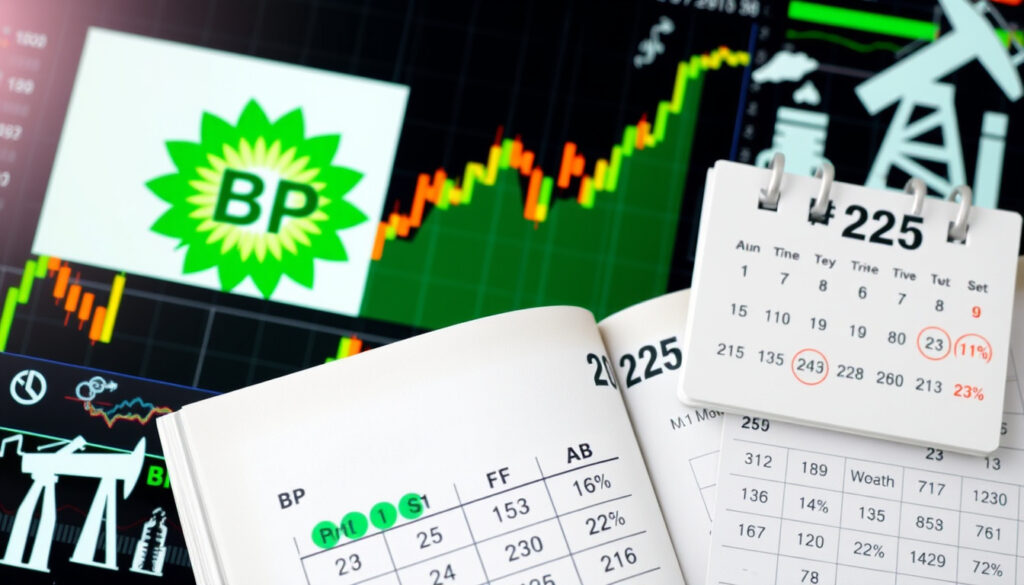
BP Share Price UK: Dividend Yield & Forecast 2025
BP’s stock has swung more than 200p in a year, creating a tension between its 4.53% dividend yield and the risk of further price drops. This article breaks down the current share price, dividend outlook, analyst forecasts, and the trade-offs for UK income investors.
Previous close: 548.40p ·
Open: 550.00p ·
Volume: 43,536,955 ·
52-week range: 397.25p – 609.40p ·
Dividend yield: 4.53%
Quick snapshot
- BP.L last traded at 548.40p (London Stock Exchange company page)
- Dividend yield stands at 4.53% (Investors Chronicle financial data platform)
- Exact date of next dividend announcement
- Future share price direction given energy transition uncertainty
- BP shares have ranged from 397.25p to 609.40p in the past 52 weeks (Investors Chronicle financial data platform)
- Next quarterly dividend expected in Q3 2025 (Investors Chronicle financial data platform)
- Analyst consensus median target: 604.38p (Investors Chronicle financial data platform)
Six key data points for BP shares on the London Stock Exchange, captured from live market feeds and analyst consensus.
| Metric | Value |
|---|---|
| Previous close | 548.40p |
| Open | 550.00p |
| Bid / Ask | 551.60p / 551.80p |
| Volume | 43,536,955 |
| 52-week high | 609.40p |
| 52-week low | 397.25p |
BP offers a dividend yield of 4.53% — attractive in a low-rate environment — but that income comes with price volatility that has seen the stock swing more than 200p in a year. For UK income investors, the trade-off is clear: cash today vs. capital uncertainty tomorrow.
What is the prediction for BP shares?
Analyst consensus for BP stock
- 19 analysts have given 12-month price targets with a median target of 604.38p, implying a 29.38% increase from the last price of 467.15p, according to Investors Chronicle financial data platform.
- The high estimate among those analysts is 699.49p; the low estimate is 429.88p (Investors Chronicle financial data platform).
- Separately, 26 analysts produced a median target of 504p in late December 2024, as reported by The Motley Fool UK investment analysis site.
- By April 2025, 27 brokers covering BP had an average share-price target of 491.1p, implying 21.2% upside from the then-current price of 405.25p (The Motley Fool UK investment analysis site).
BP share price targets 2025
Three price target layers from different periods tell a story of shifting sentiment. The Investors Chronicle median of 604.38p comes from a broader, more recent set — but it is worth noting that the median dropped to around 491p by spring 2025. The spread matters more than the average: the most optimistic broker target was 648.60p (60.1% upside), while the most pessimistic was 393.6p (a 2.9% decline) (The Motley Fool UK investment analysis site).
- The wide range (648.60p to 393.6p) reflects deep disagreement about BP’s direction.
- Key factors influencing forecasts: oil price volatility, BP’s renewable energy spending, and global economic demand.
The implication: analyst dispersion is a vote of no-confidence in a clear direction for BP’s share price.
How much is the next BP dividend?
BP ex-dividend date
BP typically pays dividends quarterly. The next ex-dividend date is expected in Q3 2025, following the company’s established pattern of four payouts per year. Shareholders must hold the stock before the ex-dividend date to qualify for the next payment.
Dividend per share amount
- BP paid a 2025 dividend of 0.33 USD per ADR-equivalent unit, up 9.26% year over year (Investors Chronicle financial data platform).
- 20 analysts expect BP dividends of 0.34 USD for the upcoming fiscal year, implying a 2.15% increase (Investors Chronicle financial data platform).
- Analysts forecast BP’s 2024 dividend per share of 23.72p would rise to 27p by 2026 (The Motley Fool UK investment analysis site).
Dividend yield calculation
Based on the latest payout and a share price of 548.40p, the trailing dividend yield is 4.53%. At 379.4p — BP’s price during one period last year — the forecast 2026 dividend of 27p would have implied a forward yield of 7.1% (The Motley Fool UK investment analysis site).
For UK retail investors, the yield is the headline story. But the yield-to-price relationship is inverse: as the share price falls, the yield rises — meaning a high yield can signal falling confidence, not bargain value. Rule of thumb: a 4.5% yield from a company cutting carbon spending may be less sustainable than it looks.
The catch: a rising yield from a falling price is a distress signal, not a value signal.
Why are BP shares dropping?
Recent performance and news
BP shares have faced downward pressure in 2025, dropping from levels near 550p to briefly below 400p before recovering. The 52-week range of 397.25p to 609.40p reflects the market’s uncertainty about oil demand, BP’s strategic pivot toward renewables, and broader macroeconomic headwinds.
Oil price impact
- BP’s earnings are closely tied to Brent crude prices. When oil drops, BP’s upstream profits fall — and so does the share price.
- Global demand concerns, particularly from China and Europe, have weighed on crude benchmarks in 2025.
Company-specific factors
- BP’s commitment to shifting from oil to renewables has created two opposing narratives: one group of investors sees long-term resilience; another sees margin pressure and unclear returns.
- The company’s debt levels and capital spending on low-carbon projects have drawn scrutiny from analysts who prefer a slower transition.
- Market sentiment indicators: 30 analysts have ratings on BP, including 11 Strong Buy, 4 Buy, 14 Hold, and 1 Strong Sell (The Motley Fool UK investment analysis site).
BP is trying to be two companies at once: a lucrative oil-and-gas business and a future clean-energy leader. Markets tend to punish hybrid narratives. Until one side clearly dominates, the stock may remain stuck in a valuation no-man’s land — not cheap enough for value hunters, not fast enough for ESG investors.
The pattern: a 14-Hold rating cluster signals that most analysts see no compelling reason to buy or sell BP shares right now.
Is it worth keeping BP shares?
Upsides
- Dividend yield of 4.53% provides steady income
- Analyst median target of 604.38p suggests upside potential
- Forecast dividend growth to 27p by 2026 implies rising payout
- BP shares are cheap on a P/E basis (5.8x) compared to the broader market
Downsides
- Price volatility: range of 397.25p–609.40p in 52 weeks
- Energy transition creates long-term uncertainty about core business
- 14 of 30 analysts rate the stock as Hold — not a vote of conviction
- Oil price dependency remains high; a sustained drop in crude hurts earnings
“BP is forecast to return 30% in 2025 — combining price appreciation and dividend income — and the shares are filthy cheap with a P/E of 5.8.”
— The Motley Fool UK investment analysis site
“We remain committed to our dividend and to delivering value for shareholders as we execute our strategy.”
— Murray Auchincloss, BP Chief Executive, BP Investor Relations company official
For UK income investors, BP’s dividend yield is among the highest in the FTSE 100. But holding BP means accepting a bet on both oil prices and the speed of the green transition. The shares offer cash today at the cost of clarity about tomorrow.
What this means: the decision to keep or sell BP shares hinges on whether you prioritise current income over capital preservation.
Are BP shares likely to go up or down?
Technical analysis overview
The current price of 548.40p sits near the midpoint of the 52-week range. While above the 397.25p low, it is below the 609.40p high — and below most analyst median targets. Technical indicators suggest the stock is in a consolidation phase after the volatility of early 2025.
Fundamental drivers
- Earnings: BP’s next quarterly results will be a key catalyst. Strong earnings could push the stock toward the 604.38p median target.
- Oil price: Brent crude above $75/bbl tends to support BP’s share price; sustained drops below $65/bbl historically trigger sell-offs.
- Dividend announcements: increases or cuts directly affect yield calculations and investor sentiment.
Short-term vs long-term outlook
In the short term (6–12 months), BP shares may rally toward analyst targets if oil prices hold and the company delivers on earnings. In the long term (3–5 years), the picture depends on BP’s ability to monetize its renewable investments without sacrificing the dividend that keeps income investors on board.
The implication: the consensus floor provided by the dividend does not remove the ceiling risk from a muddled strategy.
Related reading: **BP share price forecast for 2025** · **BP shares forecast to return 30% in 2025**
growthinvesting.net, marketbeat.com, ts2.tech, marketbeat.com, tradingview.com, uk.finance.yahoo.com, markets.businessinsider.com, gurufocus.com
For a deeper dive into the oil giant’s current valuation and income outlook, check out the BP share price LSE analysis article.
Frequently asked questions
What is BP’s dividend yield?
BP’s trailing dividend yield is 4.53%, based on the latest payout and the current share price of 548.40p (Investors Chronicle financial data platform).
When is BP’s next ex-dividend date?
BP pays dividends quarterly. The next ex-dividend date is expected in Q3 2025, following the company’s established dividend schedule.
How does BP’s share price compare to Shell?
Shell shares (LSE:SHEL) typically trade at a higher absolute price than BP, reflecting a larger market capitalisation and a different strategic focus. Both stocks offer comparable dividend yields, but Shell has historically received a valuation premium from analysts for its stronger balance sheet and clearer energy transition strategy.
What is BP’s market capitalisation?
BP’s market cap stands at approximately £81.58 billion based on the current share price (London Stock Exchange company page).
Is BP a dividend aristocrat?
BP is not classified as a dividend aristocrat (a company that has increased dividends for 25+ consecutive years), but it has maintained a consistent payout through quarterly payments, including during the pandemic when it cut dividends briefly before restoring them.
How often does BP pay dividends?
BP pays dividends on a quarterly basis — four times per year — following the standard practice for large-cap UK-listed oil companies.
What is the BP share price on the London Stock Exchange right now?
BP shares (ticker: BP.) last closed at 548.40p on 24 July 2026 (London Stock Exchange company page). As with any stock, the price updates in real time during trading hours.
For UK investors weighing BP shares today, the decision comes down to a single question: is a 4.53% yield enough compensation for a stock whose future depends on both volatile oil markets and an uncertain energy transition? If income is the priority and you can tolerate price swings, BP remains a credible payer. If growth matters more, the analyst dispersion — optimistic 648.60p targets alongside pessimistic 393.6p forecasts — should give pause. The trade-off is clear: cash now, or clarity later.
More related posts
 Canon R5 Mark II vs R5 & R6 Mark II: Specs & Value
 South Brighton Holiday Park – Beachside Cabins Near Brisbane
 Spark Store Near Me – NZ Locations, Hours & Services
 What Time Is It in Ireland? Current Time, AM/PM Guide & DST
 Eden Orchards Cherry Juice – Benefits Nutrition Reviews
 Air NZ Credit Card Comparison: Top Airpoints Earners
 Best English-Maori Translation App: Accuracy & Features (2025)
 A and C Homestore – Status, History and UK Facts