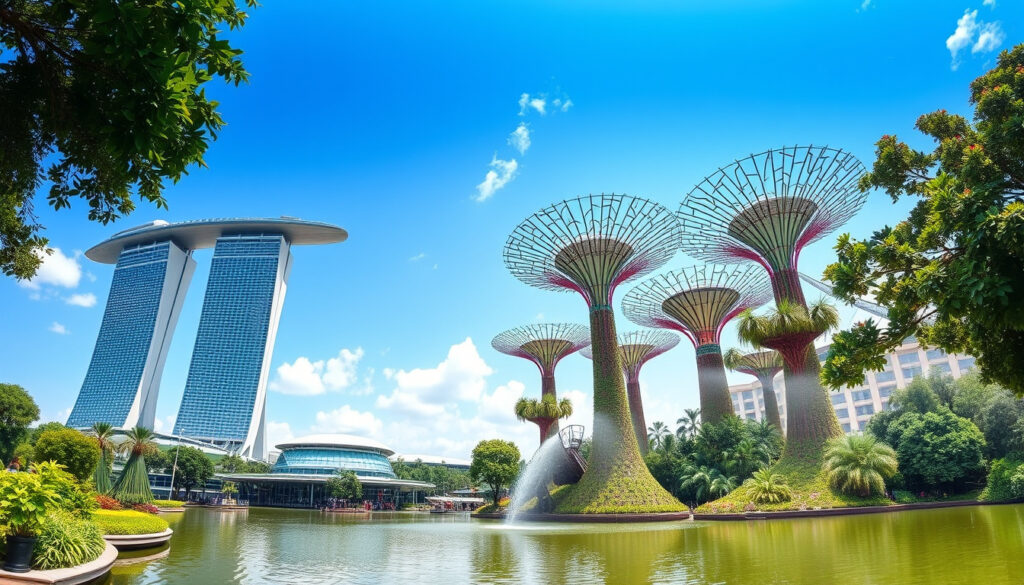
Things to Do in Singapore: Top Attractions & Tourist Rules
Singapore packs an incredible variety into a small island, attracting 13.6 million annual visitors in 2023. This guide covers the top attractions you shouldn’t miss, the strict local laws every tourist must know, and a practical 3-day itinerary that balances paid highlights with free gems.
Annual visitors (2023): 13.6 million ·
Number of hawker centers: over 110 ·
UNESCO World Heritage Sites: 1 (Singapore Botanic Gardens) ·
Average hotel stay: 3.5 days
Quick snapshot
- Gardens by the Bay light show is free and runs nightly at 7:45 PM and 8:45 PM (Anoushka Probyn travel blog)
- Chewing gum import is banned since 1992 (EHL Insights hospitality education resource)
- Singapore Botanic Gardens is a UNESCO World Heritage Site (Lonely Planet travel guide publisher)
- Exact visa-free days under the 60-90 rule vary by nationality — always check with Singapore Tourism Board
- Whether leftover gum is routinely confiscated at customs; enforcement is inconsistent (Singapore Tourism Board)
- Most major attractions can be visited in 2–3 days (Anoushka Probyn travel blog)
- Gardens by the Bay light show runs every evening — plan around it (Anoushka Probyn travel blog)
- Book Universal Studios Singapore tickets in advance for Sentosa day
- Download the MRT map and get a Singapore Tourist Pass for unlimited rides
Five key facts, one takeaway: Singapore runs on a strict-but-fair rulebook that rewards prepared travelers.
| Label | Value |
|---|---|
| Official language(s) | English, Malay, Mandarin, Tamil |
| Currency | Singapore dollar (SGD) |
| Time zone | UTC+8 |
| Emergency number | 995 (ambulance), 999 (police) |
| Plug type | Type G (three rectangular pins) — same as UK |
What are the top 5 things to do in Singapore?
Marina Bay Sands SkyPark
The observation deck at Marina Bay Sands offers panoramic views of the skyline and harbour. Lonely Planet (Lonely Planet travel guide publisher) rates it among the best viewpoints in the city. The Merlion, Helix Bridge, and ArtScience Museum form the standard Marina Bay sightseeing cluster — all within walking distance.
Gardens by the Bay
- Supertree Grove hosts a free light show nightly at 7:45 PM and 8:45 PM (Anoushka Probyn travel blog)
- The outdoor gardens are free; Cloud Forest and Flower Dome require tickets
- Marina Bay waterfront walk is a widely recommended free activity (Lonely Planet travel guide publisher)
The implication: you can enjoy the best of Gardens by the Bay without spending a cent if you time it right.
Singapore Botanic Gardens
This UNESCO World Heritage Site is a 163-year-old tropical garden that’s free to enter. Travel guides from Lonely Planet (Lonely Planet travel guide publisher) consistently recommend it for visitors wanting greenery close to the city centre. The National Orchid Garden inside charges a small fee.
Universal Studios Singapore
Located on Sentosa Island, this theme park features seven themed zones. According to 22places (22places travel list), it’s a top attraction for families and young adults. Book tickets online to skip queues.
Hawker centre food crawl
Singapore’s hawker centres are a UNESCO intangible cultural heritage. The Michelin Guide (Michelin Guide via Lonely Planet travel guide publisher) awards stars to stalls like Liao Fan Hong Kong Soya Sauce Chicken Rice & Noodle — expect meals under SGD 5. Satay Street at Lau Pa Sat operates late into the night (Anoushka Probyn travel blog).
What should you not miss in Singapore?
Chinatown heritage walk
Chinatown includes Sri Mariamman Temple, the oldest Hindu temple in Singapore, and the bustling markets along Smith Street. Free walking tours are commonly recommended as an introductory way to see the district (The Occasional Traveller blog).
Little India and Kampong Glam
Little India is a gazetted ethnic district, meaning its cultural character is legally protected. Kampong Glam offers Haji Lane’s street art and cafes. Travel itineraries from 22places (22places travel list) pair these neighborhoods as a half-day cultural walk.
Singapore River cruise
A boat ride along the Singapore River passes key landmarks including the Merlion, Raffles Landing Site, and the CBD skyline. Lonely Planet (Lonely Planet travel guide publisher) recommends it for a relaxed orientation.
Night Safari
The world’s first nocturnal zoo lets you observe animals in their nighttime habitats. Lonely Planet (Lonely Planet travel guide publisher) includes it under Mandai Wildlife Reserve, alongside Singapore Zoo, River Wonders, and Bird Paradise.
The pattern: Singapore’s cultural districts and nature attractions are compact enough to cover in a single day, but each rewards deeper exploration.
What not to do as a tourist in Singapore?
Singapore enforces strict public conduct rules that catch many visitors off guard. Here’s what you must avoid:
- Chewing gum import: Banned since 1992 (except therapeutic gum) – don’t bring it in (EHL Insights hospitality education resource)
- Smoking: Prohibited in most indoor and many outdoor spaces; designated smoking areas only (EHL Insights hospitality education resource)
- Littering or spitting: First offence fine up to SGD 1,000 (EHL Insights hospitality education resource)
- Public drinking after 10:30 PM: Banned across public spaces; Little India and Geylang have stricter weekend restrictions (EHL Insights hospitality education resource)
- Feeding pigeons: Illegal, with fines up to SGD 500 (EHL Insights hospitality education resource)
- Eating or drinking on public transport: Prohibited across MRT and buses (EHL Insights hospitality education resource)
A first-time visitor who unknowingly chews gum or drinks on the MRT faces fines that can ruin a holiday. The rules aren’t suggestions — they’re enforced.
The catch: Singapore’s strictness is exactly what makes it one of the cleanest and safest cities in the world. Follow the rules and you’ll navigate friction-free.
What is the 60-90 rule in Singapore?
The 60-90 rule refers to the visa-free stay period granted to tourists from selected nationalities. For most passport holders (US, UK, EU, Australia, NZ, Japan, South Korea), the allowance is up to 90 days. However, some nationalities receive only 30 days. The Singapore Tourism Board (Singapore Tourism Board official site) advises travelers to verify their specific visa-free duration before departure. This rule is not commonly known outside immigration contexts, so it catches many by surprise.
Is 3 days in Singapore enough?
For most first-time visitors, 3 days is enough to hit the major highlights. According to travel itineraries from Anoushka Probyn (Anoushka Probyn travel blog 3-day guide), you can easily cover Gardens by the Bay, Marina Bay, Chinatown, Little India, and a Sentosa day. Some travelers prefer 4-5 days for a more relaxed pace.
Sample 3-day itinerary
- Day 1: Marina Bay (SkyPark, Merlion, Helix Bridge) → Gardens by the Bay light show (free)
- Day 2: Chinatown → Little India → Kampong Glam → Singapore River evening cruise
- Day 3: Sentosa Island (Universal Studios or S.E.A. Aquarium) → Hawker dinner at Lau Pa Sat
What this means: 72 hours is enough to get a strong taste, but leave room to come back. Singapore rewards repeat visits.
Pros and cons of visiting Singapore
Upsides
- World-class attractions in a compact, walkable city
- Exceptional public transport (MRT covers all major areas)
- Safe and clean – low crime, strict enforcement
- Incredible food scene from hawker centres to Michelin-starred restaurants
- English widely spoken, easy to navigate
Downsides
- High cost of accommodation and alcohol
- Strict laws can catch tourists off guard (gum ban, public drinking)
- Humid and hot year-round – can be uncomfortable for outdoor exploring
- Limited nightlife beyond Clarke Quay and Sentosa
- Some attractions (Universal Studios, SkyPark) are expensive
How to plan your Singapore trip in 5 steps
- Check visa requirements: Verify your visa-free duration under the 60-90 rule via Singapore Tourism Board.
- Book flights and accommodation early: Average hotel stay is 3.5 days; book in advance for best rates.
- Get a Singapore Tourist Pass: Unlimited MRT and bus rides for 1-3 days – saves money and time.
- Plan your free vs paid activities: Mix free highlights (Gardens by the Bay outdoor, Botanic Gardens, light shows, cultural walks) with paid ones (Universal Studios, SkyPark, Night Safari).
- Pack for the climate: Light clothing, rain jacket, sunscreen, and a reusable water bottle (tap water is safe to drink).
What’s confirmed and what’s not
Confirmed facts
- Chewing gum import ban is enforced since 1992 (EHL Insights hospitality education resource)
- Gardens by the Bay light show is free and runs nightly (Anoushka Probyn travel blog)
- Universal Studios Singapore is on Sentosa Island (22places travel list)
- Singapore Botanic Gardens is a UNESCO site (Lonely Planet travel guide publisher)
- Littering fine up to SGD 1,000 for first offence (EHL Insights hospitality education resource)
What’s unclear
- Exact visa-free days for each nationality under the 60-90 rule – check with Singapore Tourism Board
- Whether leftover gum is confiscated at customs – enforcement varies
What travelers are saying
“Singapore welcomed 13.6 million visitors in 2023, reflecting a strong recovery in international travel.”
— Singapore Tourism Board (official tourism body)
“The Treetop Walk at MacRitchie Reservoir rises 25 metres above the forest floor, offering a canopy-level perspective found nowhere else in the city.”
— Lonely Planet (travel guide publisher)
“Eating or drinking on public transportation is prohibited, and fines are strictly enforced.”
— EHL Insights (hospitality education resource)
Singapore’s magic isn’t just in its attractions — it’s in the seamless blend of ultra-modern and deeply traditional, all wrapped in a rulebook that keeps things running smoothly. For a first-time visitor, the trade-off is clear: follow the local laws and you’ll enjoy one of Asia’s safest, cleanest, and most exciting cities. For the budget traveler, the choice is equally clear: hit the hawker centres and free gardens, and you can experience Singapore without breaking the bank.
kids-world-travel-guide.com, goabroad.com, youtube.com, gocity.com, reddit.com, travel.state.gov
For more details on must-see spots and updated advice, refer to this comprehensive Singapore guide before planning your trip.
Frequently asked questions
What is the best time to visit Singapore?
Singapore is warm year-round (27-31°C). February to April and July to September are considered the best months for lower rainfall. The monsoon seasons (November-January and June-August) bring heavier showers but also fewer crowds.
Do I need a visa to visit Singapore?
Many nationalities (US, UK, EU, Australia, NZ, Japan, South Korea) can visit visa-free for up to 90 days under the 60-90 rule. Others may get only 30 days. Always check with the Singapore Tourism Board before traveling.
Is Singapore expensive for tourists?
Accommodation and alcohol are pricey, but hawker meals (under SGD 5), public transport, and free attractions make it possible to visit on a mid-range budget. The average hotel stay is 3.5 days.
Can I use credit cards everywhere in Singapore?
Yes, credit and debit cards are widely accepted. Hawker stalls and some taxis may prefer cash, so carry some SGD for small purchases.
What is the tipping etiquette in Singapore?
Tipping is not customary in Singapore. A 10% service charge is usually included in restaurant bills. Tipping taxi drivers or hotel staff is not expected.
Is tap water safe to drink in Singapore?
Yes, tap water is safe to drink and meets WHO standards. Bring a reusable bottle to stay hydrated.
How do I get from Changi Airport to the city centre?
The MRT (train) from Changi Airport to the city takes about 30 minutes and costs under SGD 2. Taxis and ride-hailing apps are also available but more expensive.
What should I pack for a trip to Singapore?
Light clothing, a rain jacket, sunscreen, insect repellent, comfortable walking shoes, and a universal power adapter (Type G plug).
Related reading
More related posts
 Dragon Ball Super Broly – Canon Status, Plot and Guide
 Under the Bridge Cast: Actors, Characters & Real Story
 Cast of Crocodile Dundee: Full List & Where They Are Now
 ASUS ROG Zephyrus G14 Review: Specs, Problems & Verdict
 Pizza Sauce Recipe NZ: Quick Homemade Pantry Guide
 Blind Low Vision NZ – Library, Guide Dogs, Locations
 Apartments for Rent in Auckland: 2025 Rental Guide
 Marty Supreme Release Date: December 25, 2025 Streaming Feb 10