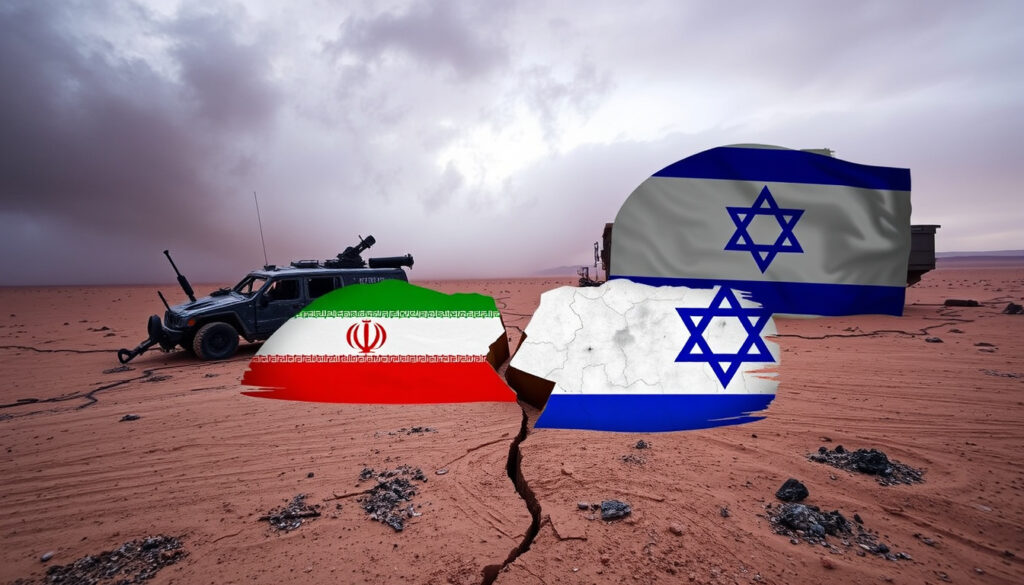
Iran and Israel War: Latest Updates & Key Questions
Few geopolitical conflicts capture the world’s attention quite like the confrontation between Iran and Israel. The latest phase began on February 28, 2026, when the US and Israel launched massive strikes on Iran, citing an imminent nuclear threat, according to the Atlantic Council. This time, a new dimension has emerged: the fight over the Strait of Hormuz. Here’s a look at what’s driving the war, who holds the cards, and what might come next.
Current conflict phase: US-Israel strikes on Iran initiated February 28, 2026 · Previous major outbreak: Twelve-Day War, June 13–24, 2025 · Stated trigger: Alleged imminent nuclear threat from Iran · Diplomatic talks: Mediated UNGA talks between Iran and US/Israel ongoing · Key demand: Iran ties talks to lifting shipping blockades and unfreezing assets
Quick snapshot
- Long-standing geopolitical and military conflict between Iran and Israel (BBC News)
- Twelve-Day War in June 2025 saw Israel bomb Iranian nuclear sites (BBC News)
- US-Israel strikes on Iran began February 28, 2026 (Atlantic Council)
- Iran is engaged in mediated UNGA talks concerning economic blockades (Associated Press)
- Whether Iran or Israel fired first in the 2026 conflict (Reuters)
- The full extent of Iran’s nuclear program capabilities (NPR)
- The immediate outcome of the ongoing UNGA talks (Associated Press)
- June 13–24, 2025: Twelve-Day War (BBC News)
- February 28, 2026: US-Israel strikes begin (Atlantic Council)
- Late August 2026: Strait of Hormuz traffic down 95% (Al Jazeera)
- Potential diplomatic resolution via UNGA talks (Associated Press)
- Continued military conflict if talks stall (Atlantic Council)
- Persistent impact on global oil markets (Reuters)
The key facts behind the Iran and Israel war can be broken into a handful of crucial data points — from military timelines to economic choke points.
| Fact | Detail |
|---|---|
| Conflict start (2025) | Twelve-Day War: June 13–24, 2025 |
| 2026 escalation | US-Israel strikes launched February 28, 2026 |
| Stated reason for 2026 strikes | Imminent nuclear threat |
| Current status | Mediated UNGA talks; Iran ties progress to lifting blockades and asset freezes |
| Key economic factor | Strait of Hormuz shipping blockade |
| Pre-war daily crossings (Hormuz) | More than 100 vessels per day |
| Post-war daily crossings (late Aug 2026) | About 5 vessels per day (95% drop) |
| Commodity vessel transit (Sept 9, 2026) | 6 vessels in one day, below 10-day average of 12 |
Why are Iran and Israel fighting?
Historical enmity
The roots of the Iran-Israel conflict stretch back decades. Iran’s 1979 Islamic Revolution ended close ties with Israel, turning the country into a vocal opponent of the Jewish state. Since then, Iran has funded proxy groups like Hezbollah and Hamas, while Israel has repeatedly struck Iranian assets in Syria and elsewhere (BBC News, UK public broadcaster).
Proxy conflicts
For years the two nations waged a shadow war. Israel targeted Iranian nuclear scientists and weapons convoys; Iran armed militias on Israel’s borders. That proxy war turned direct in June 2025, during what became known as the Twelve-Day War, when Israel bombed Iranian military and nuclear sites (BBC News).
Nuclear program dispute
At the core of the fighting lies Iran’s nuclear program. Iran insists it is peaceful, but the US and Israel believe it is seeking a bomb. The 2026 US-Israel strikes were justified as a response to an “imminent nuclear threat,” according to the Atlantic Council (Atlantic Council, Washington-based think tank).
Who started the Iran Israel war 2026?
Sequence of events
- June 2025: Israel strikes Iran in the Twelve-Day War (BBC News).
- February 28, 2026: The US and Israel launch massive strikes on Iran, claiming an imminent nuclear threat (Atlantic Council).
- Iran responds by effectively blocking traffic through the Strait of Hormuz (Atlantic Council).
Claimed triggers
The US and Israel assert that Iran was weeks away from producing a nuclear weapon. Iran denies this and accuses Israel of a preemptive attack. No independent verification of the nuclear threat has been published (NPR, US public radio).
US role
The United States is not a passive ally. It led the bombing campaign alongside Israel. The US reimposed a naval blockade on Iranian ports in July 2026, further restricting Iran’s maritime trade (Reuters, international news agency).
What is the war over between Israel and Iran?
Nuclear threat
Both sides see the nuclear program as existential. Iran views a weapon as a deterrent; Israel sees it as an unacceptable threat. The Atlantic Council notes that the US-Israel strikes were explicitly tied to “imminent nuclear threat” (Atlantic Council).
Regional influence
Iran has built a network of proxies across the Middle East — Hezbollah in Lebanon, militias in Iraq, the Houthis in Yemen. Israel sees this axis of resistance
as a direct threat to its security, especially since Iran used these groups to attack Israeli targets during the 2025 war (BBC News).
Economic resources
A new element in the 2026 conflict is the economic dimension. Iran has tied diplomatic progress to lifting shipping blockades and unfreezing its assets. The blocked Strait of Hormuz has become a bargaining chip — and a weapon. Iran’s parliament reviewed a plan to ban US, Israeli, and other “hostile” ships from the strait until Tehran is compensated for war damage (NPR).
The war is no longer just about nuclear capability — it is about who controls the world’s most critical oil chokepoint. Iran is using its geography to force economic concessions.
Who is stronger, Iran or Israel?
Five dimensions, one pattern: each side holds an advantage in a different domain, but the balance tilts in Israel’s favor militarily and Iran’s favor strategically.
| Dimension | Iran | Israel |
|---|---|---|
| Military budget (2025 est.) | ~$25 billion | ~$24 billion + $3.8 billion US aid |
| Active personnel | ~575,000 (including IRGC) | ~170,000 (plus 465,000 reserves) |
| Nuclear capability | Enriching uranium; no weapon confirmed | Undeclared nuclear arsenal widely assumed |
| Ally support | China, Russia (limited direct military aid) | United States (direct military and diplomatic backing) |
| GDP (2025, nominal) | ~$410 billion (heavily sanctioned) | ~$510 billion (diversified economy) |
The pattern here is decisive: Israel’s qualitative military edge and American backing give it the battlefield advantage, but Iran’s human capital and geographic position at Hormuz create a strategic stalemate that firepower alone cannot break. The Atlantic Council emphasizes that the blockade alone has already dealt a heavy blow to the maritime order (Atlantic Council).
If the war drags on, Iran’s economic pain intensifies but so does the global oil supply crunch. Strength isn’t just about firepower — it’s about who can outlast the other.
Why is Iran so important to the world?
Strait of Hormuz
Iran’s location on the Strait of Hormuz gives it outsize influence. A 33 km wide passage, it carries about one-fifth of the world’s oil. Before the war, over 100 vessels passed through daily. By late August 2026, that number had fallen to about five — an almost 95% drop (Al Jazeera, Qatari news network).
Oil and energy markets
The blockade has sent oil prices volatile. CNN reported that just 3,456 vessels crossed the strait in the first 172 days of the war — around 20% of normal traffic (CNN, US news network). Each drop in transit tightens global supply and raises costs for consumers.
Regional stability
Iran also influences conflicts through its proxies. Its support for Hezbollah, Hamas, and the Houthis means that any escalation risks turning into a wider regional war, potentially drawing in Saudi Arabia and the Gulf states (Al Jazeera).
Iran isn’t just a participant — it is the gatekeeper of a global energy artery. Any lasting peace will have to account for its geographic leverage, or the blockade becomes a permanent feature of the world economy.
Timeline signal
- Pre-2025: Decades of enmity, proxy conflicts, and nuclear disputes between Iran and Israel (BBC News).
- June 13–24, 2025: Twelve-Day War: Israel bombs Iranian military and nuclear sites (BBC News).
- February 28, 2026: US and Israel launch massive strikes on Iran, claiming imminent nuclear threat (Atlantic Council).
- July 16, 2026: US reimposes naval blockade on Iranian ports; fewer vessels travel through Hormuz (Reuters).
- August 26, 2026: Iran and Oman discuss temporary Hormuz routing plan; AP reports Iran would not allow military vessels in the strait under a developing agreement (Associated Press).
Confirmed facts
- Israel and Iran have a long-standing geopolitical and military conflict.
- In 2025, a Twelve-Day War occurred with Israeli bombing of Iranian nuclear sites.
- On February 28, 2026, US and Israel launched strikes on Iran citing nuclear threats.
- Iran is engaged in mediated UNGA talks concerning ending the war and economic blockades.
What’s unclear
- Whether Iran or Israel fired first in the 2026 conflict.
- The full extent of Iran’s nuclear program capabilities.
- The immediate outcome of the ongoing UNGA talks.
Quotes from the front
The strikes were necessary to neutralize an imminent nuclear threat. Iran was weeks away from a breakout capability.
— Anonymous US official, cited by the Atlantic Council (Atlantic Council)
We will not discuss peace while our ports are blockaded and our assets frozen. Diplomatic progress depends on lifting the siege.
— Iranian diplomat at UNGA, as reported by the Associated Press (Associated Press)
The Iran-Israel war is no longer a regional skirmish — it is a central hinge of the global economy. If the UNGA talks fail, the Strait of Hormuz may remain largely closed, sending oil prices higher and testing the durability of the US-Israel coalition. For world energy markets, the blockades must be resolved, or the disruption becomes the new normal that Iran’s leadership is prepared to weaponize indefinitely.
reuters.com, britannica.com, iranintl.com, english.elpais.com
Frequently asked questions
Why are the US and Israel attacking Iran?
The US and Israel claim the strikes were necessary to prevent Iran from building a nuclear weapon. Iran denies pursuing a weapon and says the attack is an act of aggression (Atlantic Council).
What happened in the 2025 Twelve-Day War?
In June 2025, Israel bombed Iranian military and nuclear sites in a confrontation that lasted 12 days, marking the first direct state-on-state clash between the two countries (BBC News).
Is the war affecting oil prices?
Yes. Traffic through the Strait of Hormuz has dropped by 95% since the war began, disrupting oil tankers and raising global crude prices (Al Jazeera).
What is the Strait of Hormuz and why is it important?
The Strait of Hormuz is a 33 km wide passage between Iran and Oman. Roughly one-fifth of the world’s oil passes through it, making it the most important oil chokepoint globally (Reuters).
Could the war expand into a wider regional conflict?
Yes. Iran’s network of proxies in Lebanon, Yemen, and Iraq could open new fronts. Saudi Arabia and the Gulf states have already increased military readiness (Al Jazeera).
What are the terms for a ceasefire?
Iran has tied any ceasefire to lifting the US naval blockade and unfreezing its assets. The US and Israel demand verified dismantling of Iran’s nuclear enrichment program (Associated Press).
Who is winning the Iran-Israel war in 2026?
Each side holds a different advantage. Israel dominates militarily with US backing, but Iran controls the Strait of Hormuz and can strangle global oil supplies, creating a strategic stalemate that neither side can break quickly (Al Jazeera).
What did Iran and Oman agree about the Strait of Hormuz?
In late August 2026, Iran and Oman discussed a temporary routing plan where inbound commercial traffic would pass through Iranian waters and outbound traffic would pass partly through Omani waters, with a permanent plan to follow within 30–60 days (Associated Press).
More related posts
 What Time Is It in Ireland? Current Time, AM/PM Guide & DST
 For I Know the Plans I Have for You – Biblical Context Explained
 Great White Shark Attacks: Facts & Survival Tips
 Happy Birthday Wishes for Friend: Heartfelt & Funny Ideas
 How to Calculate Your Tax Refund NZ: IRD Guide 2026
 TAB.co.nz NZ Racing Results Today Live – Latest Updates
 ANZ NZ Term Deposit Rates for Seniors – Current Rates and Comparisons