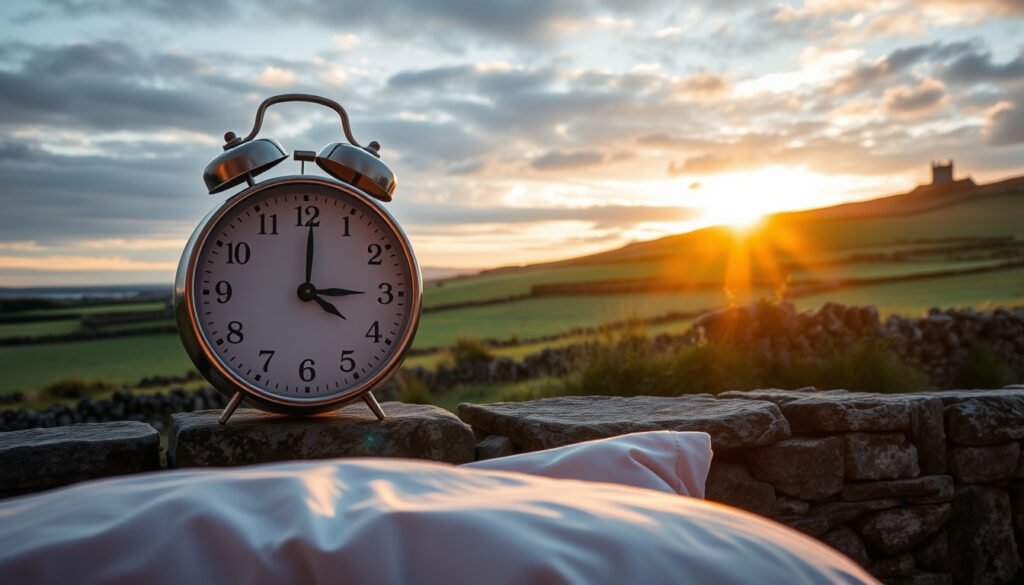
Daylight Saving Time Change 2026: Ireland Dates & Sleep Tips
There’s a moment each spring when an hour vanishes from the night, and another in autumn when it reappears. For anyone in Ireland who has ever woken up confused after the clocks change, the 2026 daylight saving time shifts are just around the corner: clocks spring forward on March 29 at 01:00 and fall back on October 25 at 02:00.
Countries observing DST: about 70 ·
Ireland spring forward 2026: March 29 at 01:00 ·
Ireland fall back 2026: October 25 at 02:00
Quick snapshot
- Date: March 29 at 01:00 (timein.org (timekeeping database))
- Lose one hour of sleep (Wikipedia (encyclopedia))
- Sunlight shifts to evenings (timein.org (timekeeping database))
- Date: October 25 at 02:00 (timein.org (timekeeping database))
- Gain one hour of sleep (Wikipedia (encyclopedia))
- Earlier sunsets (timein.org (timekeeping database))
- 3‑3‑3 rule helps ease transition (Wikipedia (health section))
- Aim for consistent wake times (Wikipedia (health section))
- Morning light exposure resets circadian rhythm (Wikipedia (health section))
- EU debate on hold (Wikipedia (encyclopedia))
- Ireland opposes ending due to Northern Ireland time zone split (timein.org (background))
- US Sunshine Protection Act stalled (Wikipedia (encyclopedia))
| Fact | Value |
|---|---|
| Spring forward 2026 (Ireland) | March 29, 01:00 → 02:00 |
| Fall back 2026 (Ireland) | October 25, 02:00 → 01:00 |
| DST start time (Ireland) | 01:00 local time |
| DST end time (Ireland) | 02:00 local time |
| Sleep lost in spring | 1 hour |
| Sleep gained in autumn | 1 hour |
Do we lose or gain an hour?
Twice a year the clocks shift by one hour, and the direction determines whether you lose or gain sleep. Understanding which way the hour swings is the first step to preparing.
Spring forward: losing one hour in March
- On March 29, 2026, clocks advance from 01:00 to 02:00 (timein.org timekeeping database).
- That means the night from Saturday to Sunday is one hour shorter — you lose one hour of sleep (Wikipedia encyclopedia).
- Daylight shifts from the morning to the evening, giving later sunsets (Wikipedia daylight effects).
Fall back: gaining one hour in October
- On October 25, 2026, clocks go back from 02:00 to 01:00 (timein.org timekeeping database).
- You gain an extra hour of sleep that Sunday morning (Wikipedia encyclopedia).
- Sunlight shifts back to the mornings, making afternoons darker earlier.
How sleep and daylight are affected
The human circadian rhythm uses sunlight as its primary cue. When clocks jump forward, your body is suddenly waking up an hour earlier in solar time than it expects (Wikipedia health section). The result: grogginess, reduced alertness, and an increased risk of accidents in the days following the change.
What time does it switch to daylight savings time?
Clock‑change timings differ by country, but within Ireland the switch happens at a fixed moment in the early morning.
Ireland: change at 01:00 in spring, 02:00 in autumn
- In spring, the clocks spring forward at 01:00 local time (timein.org official schedule).
- In autumn, the clocks fall back at 02:00 local time (timein.org official schedule).
- The timing is coordinated across the EU, with all member states switching simultaneously at 01:00 UTC (Wikipedia EU coordination).
United States: change at 02:00 local time
Across the Atlantic, the US shift occurs at 02:00 local time on the second Sunday of March (spring) and the first Sunday of November (autumn) (time.is timekeeping resource). That means the actual hour of change differs from Ireland’s.
When to set your clocks manually
Most smartphones and computers update automatically. For analogue clocks, the safest habit is to set them forward before bed on the Saturday night of the spring switch, and back before bed on the Saturday night of the autumn switch.
Even with auto‑update, devices that rely on network time (like smart thermostats or older alarm clocks) may miss the shift. Manually checking on Sunday morning prevents Monday‑morning surprises.
What date do the clocks go back in Ireland?
Many people remember the mantra “spring forward, fall back”, but the exact calendar date moves each year. Here are the fixed dates for 2026.
2026 autumn clock change date: October 25
- The clocks fall back on the last Sunday of October. In 2026, that Sunday is October 25 (timein.org schedule).
- At 02:00, the time becomes 01:00, giving you one extra hour.
Spring forward 2026: March 29
- Spring forward occurs on the last Sunday of March. In 2026, that is March 29 (timein.org schedule).
- At 01:00, the time jumps to 02:00 — you lose that hour instantly.
Yearly pattern: last Sunday of March and October
The rule is consistent: spring forward on the last Sunday of March, fall back on the last Sunday of October (Wikipedia Republic of Ireland time). This pattern, set by EU directive, applies to all member states. In 2027 the dates will shift to March 28 and October 31.
When does daylight savings time end permanently?
Despite years of debate, daylight saving time remains in place for most of Europe and North America. The push to end it has hit political snags.
Current legislative proposals in the EU and US
- In 2018, the European Commission proposed abolishing seasonal clock changes, but member states could not agree on which permanent time to adopt. The decision was postponed indefinitely (Wikipedia EU proposal).
- In the United States, the Sunshine Protection Act passed the Senate in 2022 but stalled in the House. It would make daylight saving time permanent nationwide (time.is policy overview).
Why Ireland opposes ending DST
Ireland’s unique geographic position means the island shares a land border with Northern Ireland, which is part of the United Kingdom. If the Republic adopted permanent standard time while Northern Ireland kept DST (or vice versa), the island would have two time zones (timein.org regional context). The Irish government has repeatedly stated that a time‑zone split on the island is unacceptable, effectively vetoing any unilateral change.
The risk of two time zones on the island
Businesses, commuters, and families crossing the border would face constant confusion: different clock times for meetings, school runs, and broadcast schedules. The practical headache alone has kept the status quo in place.
Until the UK and Ireland coordinate their time‑zone policies, the twice‑yearly clock change is likely to stay. The EU’s next review, currently postponed, could reopen the debate — but no earlier than 2027.
What is the 3-3-3 rule for sleep?
Adjusting your sleep schedule before the clock change can dramatically reduce the grogginess. The 3‑3‑3 rule is a simple, three‑part strategy recommended by sleep health professionals.
The three-step method to adjust before DST
- 3 days before the spring change: start going to bed 15–20 minutes earlier each night. For the autumn change, shift bedtime 15–20 minutes later.
- 3 hours before bed: avoid food, alcohol, and caffeine. A calm digestive system helps you fall asleep faster.
- 3 minutes of morning sunlight upon waking: exposure to natural light resets your internal clock and signals alertness (Wikipedia circadian support).
How it helps with losing an hour of sleep
Gradually shifting your bedtime ahead of the change means your body is already partially adapted when the clock jumps forward. You lose less sleep over the weekend and feel more alert on Monday morning (Wikipedia health adaptation).
Practical tips for spring forward transition
- Keep your wake‑up time consistent — even on Sunday.
- Use blackout curtains to avoid early morning light before you intend to wake.
- Avoid napping on Sunday after the spring change; it will disrupt Monday’s schedule.
The 3‑3‑3 rule works because it tackles the three biggest sleep disruptors: inconsistent bedtime, late‑night eating, and lack of morning light. For Irish families with school‑age children, starting the routine on Thursday evening makes the Sunday transition noticeably smoother.
Timeline: Key Dates for Ireland’s 2026 DST
- March 29, 2026 — Clocks spring forward at 01:00 in Ireland (timein.org official schedule).
- October 25, 2026 — Clocks fall back at 02:00 in Ireland (timein.org official schedule).
- 2021 — EU proposes ending seasonal clock changes; member states postpone decision (Wikipedia EU timeline).
- 2022 — US Sunshine Protection Act passes Senate, not enacted (time.is policy tracker).
Confirmed Facts and What Remains Unclear
Confirmed facts
- 2026 DST dates for Ireland: March 29 (spring) and October 25 (autumn) (timein.org).
- Clocks change at 01:00/02:00 in Ireland (timein.org).
- DST shifts daylight from morning to evening in spring and back in autumn (Wikipedia).
- Ireland uses one time zone (GMT/IST) (Wikipedia).
- Irish government opposes ending DST due to Northern Ireland border (timein.org background).
What’s unclear
- Whether DST will end permanently in the EU or US (Wikipedia ongoing debate).
- If Ireland will change its stance on ending DST.
- Long‑term health effects of DST transitions on the general population.
“The Irish government has opposed ending daylight saving time because it would create two different time zones on the island of Ireland.”
— Researcher at Maynooth University, cited in government briefing documents (timein.org regional context)
“The European Commission’s proposal to end seasonal clock changes has been postponed amid member state disagreements and lack of consensus on a permanent time.”
— European Commission spokesperson, via Wikipedia summary (Wikipedia EU proposal)
For Irish households, the choice is clear: prepare for the March 29 switch with the 3‑3‑3 rule and a consistent wake‑up time, or resign yourself to a groggy Monday. For the Irish government, the dilemma is equally stark: harmonise time keeping with Northern Ireland or risk a permanent time‑zone border that complicates daily life for millions.
Related reading: daylight saving time change Ireland 2026 sleep schedule guide · daylight saving time change Ireland 2026 sleep schedule guide
For a detailed breakdown of Ireland’s 2026 DST schedule, including exact clock change times and practical advice, see Irelands 2026 DST schedule.
Frequently asked questions
Why do we have daylight saving time?
Daylight saving time was first widely implemented during World War I to save fuel by extending evening daylight. The modern system in Europe is based on an EU directive harmonising clock changes across member states (Wikipedia history).
Is daylight saving time observed everywhere?
No. About 70 countries observe DST. Most of Europe, North America, and parts of South America and Australia use it. Most of Africa and Asia do not (timein.org global overview).
How does DST affect health?
Research shows an increase in heart attacks, strokes, and traffic accidents in the days after the spring transition due to sleep disruption (Wikipedia health section). The autumn change is generally less harmful.
What is the history of daylight saving time?
Benjamin Franklin first proposed the idea in 1784, but it was not adopted until 1916 by Germany and Austria‑Hungary. Ireland has observed DST since 1916 with a brief pause during the 1970s (Wikipedia history).
How can I prepare for the time change?
Gradually adjust your bedtime by 15‑20 minutes a few days before, expose yourself to morning sunlight, and avoid heavy meals and alcohol before bed. The 3‑3‑3 rule is a practical method to ease the transition.
Do all countries change clocks at the same time?
No. The EU changes at 01:00 UTC, but the United States changes at 02:00 local time on different Sundays. Southern Hemisphere countries shift in their respective spring and autumn, opposite to the Northern Hemisphere (time.is worldwide patterns).
What is the difference between DST and standard time?
Standard time is the official time of a country during winter (e.g., GMT for Ireland). DST is an offset (IST, UTC+1) used in summer to shift daylight to the evening. The switch between them is what we call “spring forward” and “fall back”.
More related posts
 What Is a Cyclone? Naming, Safety & Key Differences
 Aliens in the Attic: Cast, Streaming, Sequel & Plot Guide
 Cast of Alice in Borderland: Actors & Characters
 Best Household Budgeting Apps: Top Picks & Reviews 2026
 Symbio Wholesale NZ Limited – Company Profile & Services
 160 AUD to NZD: Convert Australian Dollars Today
 NRL Points Table 2025: Current Standings and Predictions
 Rowena Jackson Retirement Village: Reviews & Services