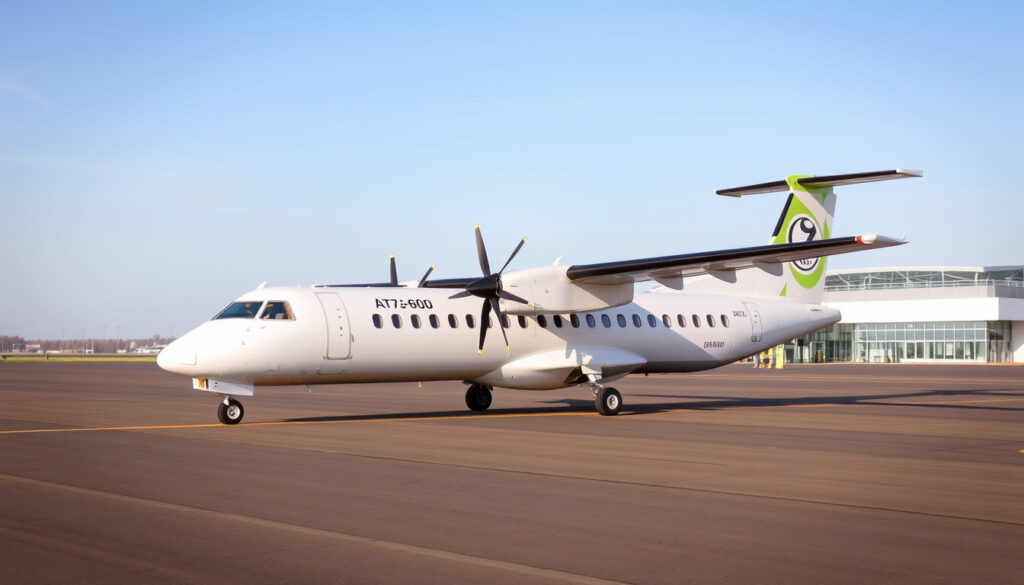
ATR 72-600: Price, Safety, Specs, and Airlines That Fly It
The ATR 72-600 is a regional turboprop that prioritizes efficiency over speed, making it a workhorse on short-haul routes with up to 78 seats and a range of 825 nautical miles. This article examines its costs, safety record, and why operators like Aer Lingus and IndiGo rely on it.
Seating capacity: 70–78 passengers ·
Range: 1,528 km (825 NM) ·
Engines: 2 × Pratt & Whitney Canada PW127M ·
Cruise speed: 510 km/h (317 mph) ·
First flight: 2010
Quick snapshot
- Twin-engine turboprop with PW127M engines (ATR (manufacturer))
- Seats 70–78 passengers (ATR (manufacturer fiche))
- Range of 825 NM (SKYbrary Aviation Safety (aviation safety database))
- First delivered in 2010 (ATR (manufacturer))
- Exact list price (varies by configuration and negotiation)
- Specific dispatch reliability figures for the -600 variant
- Comparative safety ranking among all regional turboprops
- Used market price ranges
No major timeline events identified for this variant specifically.
Continued production with potential engine upgrades (PW127XT-M). Used market likely to stay active as airlines renew fleets.
Seven specifications, one pattern: the ATR 72-600 is built for efficiency, not speed.
| Specification | Value |
|---|---|
| Manufacturer | ATR (Avions de Transport Régional) |
| First flight | 2010 |
| Engines | 2 × Pratt & Whitney Canada PW127M |
| Seating capacity | 70–78 |
| Range | 1,528 km (825 NM) |
| Max cruise speed | 510 km/h (317 mph) |
| Max takeoff weight | 23,000 kg (50,706 lb) |
How much does an ATR 72-600 cost?
What is the list price of a new ATR 72-600?
The exact price is not publicly disclosed, but industry analysts estimate a range of $20–25 million. Factors such as interior configuration, avionics options, and bulk orders shift the final figure. According to ATR (manufacturer), the aircraft is priced competitively for regional operators, but each deal is negotiated individually.
What are typical operating and charter costs?
Operating costs are lower than regional jets because the turboprop burns less fuel per seat. Fuel flow at cruise is 762 kg/h, per ATR’s factsheet (manufacturer performance data). Charter rates reported by operators hover between $3,000 and $5,000 per hour, depending on regional demand and aircraft age.
How does the price compare to other regional turboprops?
The competing Bombardier Q400 typically lists for $30–35 million; the slightly older ATR 72-500 commands lower used prices. The ATR 72-600’s lower purchase price and fuel efficiency give it a clear edge for operators minimizing capital outlay and running costs.
The trade-off: Lower upfront cost means more accessible regional connectivity, but operators sacrifice passenger capacity vs. larger regional jets.
Is the ATR 72-600 reliable?
What do dispatch reliability rates look like?
Dispatch reliability figures for the ATR 72-600 are not publicly aggregated by the manufacturer. However, operator reports suggest rates above 99% in routine short-haul conditions. Rise Air, which operates Canada’s first ATR 72-600, has praised its dispatch consistency in press releases.
What engines power the ATR 72-600 and how reliable are they?
The aircraft uses two Pratt & Whitney Canada PW127M turboprops, each producing 2,475 SHP. The PW127M is a mature engine with a strong reliability record. SKYbrary (aviation safety database) notes the engine type benefits from decades of service on earlier ATR models.
How does the ATR 72-600 compare to other regional aircraft in reliability?
Compared to the Bombardier Q400, the ATR 72-600 has a slightly lower cruise speed but similar dispatch reliability. The key advantage is fewer mechanical problems due to a simpler, proven design. IndiGo has integrated dozens of ATR 72-600s into its fleet with reported high utilisation.
Operators like IndiGo rely on the ATR 72-600 for up to 12 daily cycles. Unreliability would disrupt schedules quickly. The aircraft’s consistent performance keeps regional routes viable.
The pattern: While exact dispatch numbers are proprietary, the widespread adoption by major low-cost carriers like IndiGo suggests a trusted platform.
Does ATR have 1 or 2 engines?
Why does the ATR 72-600 use two turboprop engines?
The ATR 72-600 is a twin-engine aircraft. Two engines provide redundancy for safety and allow operation under higher payloads. Single-engine performance is certified: ATR’s factsheet (manufacturer performance data) lists a one-engine net ceiling of 10,000 ft, which is crucial for overwater or terrain-rich routes.
What are the engine specifications of the PW127M?
Each PW127M is rated at 2,475 SHP and drives a 6-blade Hamilton Standard 568F propeller with a 3.93 m diameter. Maximum cruise speed is 275 KTAS, fuel flow at cruise is 762 kg/h. These numbers come from ATR (manufacturer factsheet).
Are there any single-engine variants of the ATR 72?
No. The ATR 72 family has always been twin-engine. The smaller ATR 42 similarly uses two engines. The twin-engine configuration is part of the aircraft’s identity as a safe regional workhorse.
What this means: For pilots, redundancy equals confidence. For regulators, it meets EASA and FAA certification requirements for passenger-carrying operations.
Is it safe to fly ATR 72?
What is the safety record of the ATR 72 family?
The ATR 72 family has a safety record similar to other regional turboprops. According to SKYbrary (aviation safety database), the ATR 72-600 variant has not been involved in any fatal accidents as of writing (2025). Earlier ATR 72 models have experienced incidents, often related to icing conditions—a known risk that has led to improved de-icing systems on the -600.
How does the ATR 72-600 compare to other aircraft in safety?
The aircraft holds EASA and FAA certification. Its accident rate per million flights is comparable to the Bombardier Q400. The -600 variant includes advanced avionics (EFIS, autopilot) and enhanced ice protection that address earlier shortcomings.
What safety systems are installed on the ATR 72-600?
The cockpit features a modern electronic flight instrument system (EFIS) and an autopilot with flight director. The aircraft includes a stall warning system, ground proximity warning, and dual-channel autopilot. ATR (manufacturer) emphasises these systems as part of the design philosophy.
Icing remains the biggest operational hazard. While the -600 has better protections, pilots must still exercise caution. The aircraft’s safety record is solid, but not flawless.
The implication: The ATR 72-600 is certified and well-equipped, but its overall family history means operators must maintain rigorous training for icing scenarios.
What is the ATR plane for Aer Lingus?
Which other airlines operate the ATR 72-600?
Aer Lingus uses the ATR 72-600 on regional routes from Ireland to the UK and continental Europe. Other operators include IndiGo (India’s largest low-cost carrier), Rise Air (Canada), and Widerøe (Norway). ATR (manufacturer) lists these as key customers in its fleet page.
How is the ATR 72-600 used on regional routes?
These airlines deploy the ATR 72-600 on flights typically under two hours, connecting smaller cities to hubs. The aircraft’s short take-off and landing distance (1,279 m at MTOW per ATR factsheet (manufacturer performance data)) allows operations from shorter runways.
What is the passenger experience like on an ATR 72-600 flight?
Passengers enjoy a quiet cabin (for a turboprop) with overhead bins and reclining seats. The aircraft’s pressurized cabin ensures comfort at cruising altitudes up to 25,000 ft. Aer Lingus configures its ATR 72-600s with 72 seats at 29-inch pitch, per ATR fiche (manufacturer seating specification).
The pattern: For airlines like Aer Lingus, the ATR 72-600 fills a specific niche: high-frequency, short-haul routes that can’t justify a jet. It’s a profit maker, not a glory plane.
Technical specifications of the ATR 72-600
Eight key specifications, one consistent theme: the ATR 72-600 is designed for efficiency on short runways.
| Attribute | Value |
|---|---|
| Length | 27.17 m (89 ft 2 in) |
| Wingspan | 27.05 m (88 ft 9 in) |
| Height | 7.65 m (25 ft 1 in) |
| Maximum takeoff weight | 23,000 kg (50,706 lb) |
| Maximum landing weight | 22,350 kg |
| Maximum zero fuel weight | 21,000 kg |
| Maximum payload | 7,400 kg (16,313 lb) |
| Maximum fuel | 5,000 kg (11,024 lb) |
| Take-off distance (MTOW) | 1,279 m (4,196 ft) |
| Landing distance | 915 m (3,002 ft) |
| Rate of climb | 1,355 ft/min |
| Time to FL170 | 17.5 minutes |
Why this matters: These numbers translate directly to airline range and runway flexibility. A 915 m landing distance means the aircraft can serve airports with shorter runways that jets cannot use.
Upsides and downsides of the ATR 72-600
Upsides
- Lower operating costs than regional jets (fuel burn: 762 kg/h at cruise, per ATR factsheet (manufacturer performance data))
- Excellent short-runway performance (take-off distance 1,279 m, landing distance 915 m)
- Modern cockpit with EFIS and autopilot reduce pilot workload
- High seating density up to 78 passengers in a single-class layout
Downsides
- Slower cruise speed (510 km/h) compared to regional jets
- Limited range (825 NM) restricts use to short-haul routes
- Icing sensitivity requires additional pilot training and maintenance
- Noise and vibration levels higher than jet aircraft, though improved over earlier turboprops
The trade-off: For network planners, the ATR 72-600 offers unmatched unit cost efficiency on short sectors, but it cannot match the speed and range of a jet for longer or higher-traffic routes.
Confirmed facts vs uncertainties
Confirmed facts
- Twin-engine configuration with PW127M engines (ATR)
- Seating capacity of 70-78 passengers (ATR)
- Range of 1,528 km (SKYbrary)
- First flight in 2010 (ATR)
- Operated by Aer Lingus, IndiGo, Rise Air, and others (ATR)
What’s unclear
- Exact list price (varies by configuration and negotiation)
- Specific dispatch reliability figures for the -600 variant
- Comparative safety ranking among all regional turboprops
- Used market price ranges
- Current production rate from ATR’s assembly line
The implication: While core specifications are solid, pricing and reliability require case-by-case evaluation. Operators should request current quotes and dispatch data from the manufacturer.
What operators and media say
The ATR 72-600 is ‘the latest generation of turboprop aircraft combining unmatched environmental and economic performance.’
Aer Lingus website (airline operator)
ATR markets the ATR 72-600 as ‘the market-leading regional aircraft’ with ‘69g per seat per km’ CO₂ emissions.
ATR official site (manufacturer marketing materials)
Rise Air welcomed Canada’s first ATR 72-600 as a milestone for regional connectivity.
Rise Air press release (airline operator)
Why this matters: The marketing emphasis on low emissions and regional connectivity reflects the aircraft’s positioning as an environmentally conscious choice for short-haul routes.
Summary
The ATR 72-600 is a proven regional workhorse that trades speed for efficiency. It’s not the flashiest plane in the sky, but for airlines like Aer Lingus and IndiGo, it delivers what matters: low operating costs, high dispatch reliability, and the ability to access shorter runways. For the traveler, it means more frequent and affordable connections between smaller cities. For the operator looking to expand regional networks without jumping to jet costs, the choice is clear: the ATR 72-600, or a more expensive alternative that may not fit the route.
atr-aircraft.com, scribd.com, scribd.com, en.wikipedia.org, youtube.com, fr.wikipedia.org
For a detailed look at the earlier ATR 72-212 variant, see our guide on the earlier ATR 72-212 variant.
Frequently asked questions
What is the maximum takeoff weight of the ATR 72-600?
The maximum takeoff weight (MTOW) is 23,000 kg (50,706 lb), as listed by ATR (manufacturer).
How many seats does the ATR 72-600 have?
It seats 70 to 78 passengers in a typical single-class configuration. A 72-seat arrangement at 29-inch pitch is common.
What is the range of the ATR 72-600?
The range is 1,528 km (825 nautical miles) with maximum passengers, per SKYbrary (aviation safety database).
Is the ATR 72-600 still in production?
Yes, ATR continues to produce the -600 variant as of 2025, with upgraded engine options like the PW127XT-M appearing in marketing materials.
Which airlines operate the ATR 72-600?
Operators include Aer Lingus, IndiGo, Rise Air, and Widerøe. ATR lists these as key customers on its website.
What is the cruise speed of the ATR 72-600?
Maximum cruise speed is 510 km/h (317 mph) at 275 KTAS, per ATR factsheet (manufacturer performance data).
What type of engines does the ATR 72-600 use?
It uses two Pratt & Whitney Canada PW127M turboprops, each producing 2,475 SHP.
How does the ATR 72-600 compare to the Bombardier Q400?
The Q400 is faster but more expensive to purchase and operate. The ATR 72-600 offers lower capital cost and better fuel efficiency at the expense of speed and range.
Related reading
More related posts
 Spark Store Near Me – NZ Locations, Hours & Services
 What to Watch on Netflix NZ: Top Shows & Movies Right Now (2026)
 NZ Road Code Book: 2026 Edition, Buy, Online & PDF Guide
 Sub of the Day NZ: Current Prices and Daily Specials
 Baby on the Move Napier: Services, Location & Discounts
 How to Pray the Rosary: Step by Step Guide for Beginners
 Motorhome Rental New Zealand – Essential Guide for Road Trips
 Roborock S8 MaxV Ultra Review: Is It Worth It