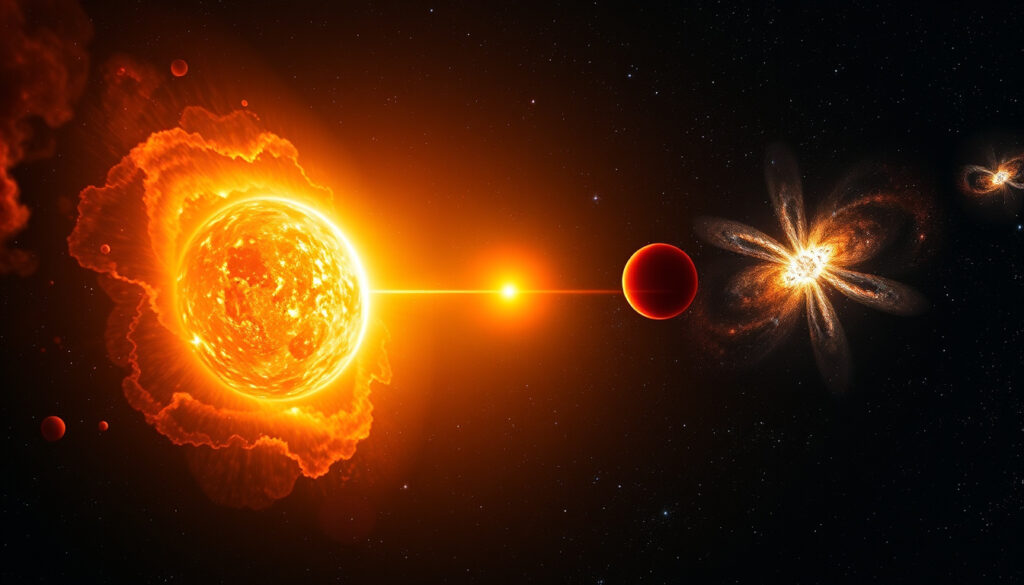
Life Cycle of a Star: Stages, Evolution & Final Fate
There’s something quietly humbling about staring up at a starry sky and knowing that each speck of light has its own story — a birth, a long middle age, and eventually, an ending. Some stars live for trillions of years; others race through their lives in just a few million.
Lifespan range: Few million to trillions of years ·
Main sequence duration: About 90% of a star’s life ·
Sun’s main sequence: Approximately 10 billion years
Quick snapshot
- Nebula collapses due to gravity (NASA’s Imagine the Universe! (space science education))
- Protostar forms (The Schools’ Observatory (astronomy education))
- Nuclear fusion ignites (KiwiCo (science education platform))
- Stable hydrogen burning (KiwiCo (science education platform))
- Lasts 90% of star’s life (The Schools’ Observatory (astronomy education))
- Size and temperature vary by mass (NASA’s Imagine the Universe! (space science education))
- Red giant or supergiant (The Schools’ Observatory (astronomy education))
- Helium fusion and beyond (NASA’s Imagine the Universe! (stellar evolution guide))
- Planetary nebula or supernova (NASA’s Imagine the Universe! (stellar evolution guide))
- White dwarf (low mass) (NASA’s Imagine the Universe! (stellar evolution guide))
- Neutron star or black hole (high mass) (NASA’s Imagine the Universe! (space science education))
Four key facts, one pattern: every stage depends on the star’s original mass — low-mass stars follow a quiet, drawn-out path, while their massive cousins burn hot and die spectacularly.
| Fact | Value |
|---|---|
| Number of stages | Typically 7 (depending on mass) |
| Sun’s current stage | Main sequence, ~4.6 billion years old |
| Largest known star | UY Scuti, a red supergiant |
| Most common star type | Red dwarfs (low mass, long-lived) |
What is the life cycle of a star step by step?
Nebula and protostar formation
- Stars form from dense clouds of gas and dust called nebulae, where gravity pulls material together into a protostar (NASA’s Imagine the Universe! (space science education)).
- As the protostar contracts, its core temperature rises until nuclear fusion of hydrogen into helium ignites (KiwiCo (science education platform)).
The implication: a star’s birth is a competition between gravity pulling inward and fusion pushing outward — when balance is reached, the star enters its longest phase.
Main sequence stage
- During main sequence, the star steadily fuses hydrogen in its core; this stage lasts about 90% of the star’s total life (The Schools’ Observatory (astronomy education)).
- The Sun is currently about 4.6 billion years into its main sequence and is roughly halfway through this phase (The Schools’ Observatory (astronomy education)).
The pattern: the more massive the star, the faster it burns fuel — a 10-solar-mass star may stay on the main sequence for only 20 million years, while a red dwarf can chug along for trillions.
Red giant or supergiant phase
- When core hydrogen runs out, fusion moves to a shell around the core, causing the star to swell into a red giant (for low-mass stars) or red supergiant (for high-mass stars) (The Schools’ Observatory (astronomy education)).
- For a Sun-like star, the outer layers can expand to several hundred times its original size (KiwiCo (science education platform)).
Why this matters: at this point, the star begins to lose mass rapidly through stellar winds, and the eventual remnant is determined by how much mass remains.
Final states: white dwarf, neutron star, black hole
- A Sun-like star sheds its outer layers as a planetary nebula, leaving behind a white dwarf that cools over billions of years (NASA’s Imagine the Universe! (stellar evolution guide)).
- Massive stars, after a supernova, collapse into neutron stars or black holes depending on the original mass (NASA’s Imagine the Universe! (space science education)).
The implication: a star’s mass writes the entire story, from birth to final resting place.
What are the 7 stages of star formation?
Stage 1: Giant molecular cloud
- Stars begin in a giant molecular cloud (a dense nebula) that contracts under its own gravity (NASA’s Imagine the Universe! (space science education)).
Stage 2: Protostar
- As the cloud collapses, a protostar forms at the centre, accumulating mass from the surrounding envelope (The Schools’ Observatory (astronomy education)).
Stage 3: T Tauri phase
- For Sun-like stars, a pre-main-sequence phase called T Tauri occurs, characterised by strong stellar winds and variability (Wikipedia (open encyclopedia)).
Stage 4: Main sequence
- Hydrogen fusion ignites and stabilises, marking the start of the main sequence — the longest and most stable period (KiwiCo (science education platform)).
Stage 5: Red giant
- After core hydrogen is exhausted, the star expands into a red giant (or red supergiant for massive stars) (The Schools’ Observatory (astronomy education)).
Stage 6: Fusion of heavier elements
- In the core, helium fuses into carbon and oxygen; in massive stars, further fusion creates elements up to iron (NASA’s Imagine the Universe! (space science education)).
Stage 7: Supernova and remnant
- For massive stars, the iron core collapses, triggering a supernova that leaves behind a neutron star or black hole (NASA’s Imagine the Universe! (space science education)).
The catch: the seven-stage sequence applies neatly to intermediate-mass stars like the Sun, but low-mass red dwarfs skip the heavy-element fusion and never reach supernova.
A star’s mass doesn’t just influence its lifetime — it redraws the entire stage play. Red dwarfs, the most common stars in the galaxy, will be among the last to fade, outliving every blue supergiant by trillions of years.
How long is the life cycle of a star?
Factors affecting stellar lifetime
- A star’s lifetime is determined almost entirely by its mass: more mass means more gravitational pressure, faster fusion, and a shorter life (NASA’s Imagine the Universe! (space science education)).
Low-mass star lifetimes
- Red dwarfs (less than half the Sun’s mass) can burn hydrogen so slowly that their lives stretch into trillions of years — far longer than the current age of the universe (Wikipedia (open encyclopedia)).
High-mass star lifetimes
- Very massive stars (tens of solar masses) may live only a few million years; some race through their entire evolution in just a few hundred thousand years (The Schools’ Observatory (astronomy education)).
Comparison with the Sun
- The Sun is about 4.6 billion years old and is expected to remain on the main sequence for another 5 billion years or so, reaching a total main-sequence lifespan of roughly 10 billion years (The Schools’ Observatory (astronomy education)).
The trade-off: a star that burns brightest burns fastest. The most massive stars are cosmic fireworks — spectacular, but gone in a geological blink.
What determines a star’s final fate?
Mass threshold for white dwarf formation
- Stars with initial mass less than about 8 times the Sun’s mass end their lives as white dwarfs, supported against further collapse by electron degeneracy pressure (Wikipedia (open encyclopedia)).
Neutron star from core-collapse supernova
- Stars between roughly 8 and 20 solar masses explode as supernovae, leaving behind a neutron star — a city-sized object where matter is compressed to nuclear densities (Wikipedia (open encyclopedia)).
Black hole from the most massive stars
- Stars over about 20 solar masses collapse directly into a black hole after the supernova, producing a gravitational trap from which not even light can escape (NASA’s Imagine the Universe! (space science education)).
What this means: the outcome is sealed long before the star’s final moment — no detours, no second chances.
What are the different types of stellar remnants?
White dwarfs and their properties
- A white dwarf is the hot, dense core left after a Sun-like star sheds its outer layers; it is supported by electron degeneracy pressure and slowly fades into a black dwarf (NASA’s Imagine the Universe! (stellar evolution guide)).
- According to NASA, a Sun-like star typically retains only about 20% of its original mass as a white dwarf (NASA’s Imagine the Universe! (stellar evolution guide)).
Neutron stars and pulsars
- Neutron stars are incredibly dense — a teaspoon of neutron star material would weigh billions of tons on Earth (NASA’s Imagine the Universe! (space science education)).
- Some neutron stars spin rapidly and emit beams of radiation, appearing as pulsars (Wikipedia (open encyclopedia)).
Black holes and event horizons
- Black holes form when the core of a very massive star collapses past the point of no return; the event horizon marks the boundary from which nothing can escape (NASA’s Imagine the Universe! (space science education)).
The pattern: each remnant represents a different balance between gravity and quantum pressure. White dwarfs use electron pressure, neutron stars use nuclear forces, and black holes give in entirely.
Life Cycle Steps at a Glance
- Step 1 – Nebula: A giant cloud of gas and dust begins to collapse under gravity.
- Step 2 – Protostar: Material gathers at the centre, forming a hot protostar.
- Step 3 – T Tauri (for Sun-like stars): A turbulent pre-main-sequence phase with strong winds.
- Step 4 – Main sequence: Stable hydrogen fusion powers the star for most of its life.
- Step 5 – Red giant/supergiant: Core hydrogen exhausted; star expands dramatically.
- Step 6 – Fusion of heavier elements: Helium and beyond; massive stars create iron.
- Step 7 – Remnant: Planetary nebula + white dwarf (low mass) or supernova + neutron star/black hole (high mass).
What this means: these seven steps compress billions of years of stellar physics into a framework that works for most stars — though red dwarfs and the most massive giants each take their own shortcuts.
Confirmed facts
- Stars are born in nebulae (NASA’s Imagine the Universe!)
- Fusion converts hydrogen to helium in main sequence stars (KiwiCo (science education))
- Final state depends on mass (NASA’s Imagine the Universe!)
What’s unclear
- Exact trigger for core collapse in massive stars (NASA’s Imagine the Universe!)
- Nature of dark matter influence on star formation (Wikipedia (open encyclopedia))
- Precise lifetime of the most massive stars remains uncertain due to their rarity and rapid evolution (The Schools’ Observatory (astronomy education))
Quotes from the experts
Stars are giant balls of hot gas – mostly hydrogen, with some helium and small amounts of other elements.
— NASA Star Basics
Gravity and nuclear fusion reactions drive the formation and development of stars.
— BBC Bitesize
For a student looking at the night sky for the first time, the choice is simple: mass writes the story. Understand that single number, and you understand why some stars live for trillions of years while others die in a flash, leaving behind the heaviest objects in the universe.
Every atom heavier than helium in your body was forged inside a star and scattered by a supernova. The life cycle of a star isn’t just an astronomy lesson — it’s the story of where we all come from.
Frequently asked questions
What is a nebula?
A nebula is a vast cloud of gas and dust in space, often the birthplace of stars. Gravity can cause parts of a nebula to collapse and form protostars.
How does a star become a red giant?
When a star exhausts the hydrogen in its core, fusion continues in a shell around the core. The extra energy pushes the outer layers outward, causing the star to swell into a red giant.
What happens inside a main sequence star?
In the core, hydrogen nuclei fuse into helium under extreme temperature and pressure, releasing enormous amounts of energy that counteracts gravity and keeps the star stable.
Why do massive stars explode as supernovae?
Massive stars fuse elements up to iron in their cores. Once iron builds up, no further fusion happens, the core collapses in less than a second, and the rebound shock wave produces a supernova.
What is the difference between a white dwarf and a neutron star?
A white dwarf is the remnant of a low-mass star, supported by electron degeneracy pressure. A neutron star is the remnant of a massive star after a supernova, supported by neutron degeneracy pressure and far denser.
Can a star become a black hole without a supernova?
Some very massive stars may collapse directly into a black hole without a visible supernova, if the collapse is too deep for the shock to escape. This is called a failed supernova.
How long does the Sun have left to live?
The Sun is about 4.6 billion years old and is expected to remain on the main sequence for another 5 billion years, before turning into a red giant and eventually a white dwarf.
What is the eventual fate of the Sun?
The Sun will become a red giant, shed its outer layers into a planetary nebula, and leave behind a white dwarf that will cool over billions of years into a black dwarf.
More related posts
 Seek Jobs in New Zealand: Roles & Visa Tips
 Are Black Friday travel deals worth it? A fact-checked guide
 Free Hearing Test Online – What They Can and Cannot Do
 Best Household Budgeting Apps: Top Picks & Reviews 2026
 Cast of Crocodile Dundee: Full List & Where They Are Now
 Upgrade to Windows 11: Free Guide & Compatibility Check
 How to Book an Air New Zealand Flight Online
 Ready Made Curtains NZ: Prices, Sizes & Retailers 2025