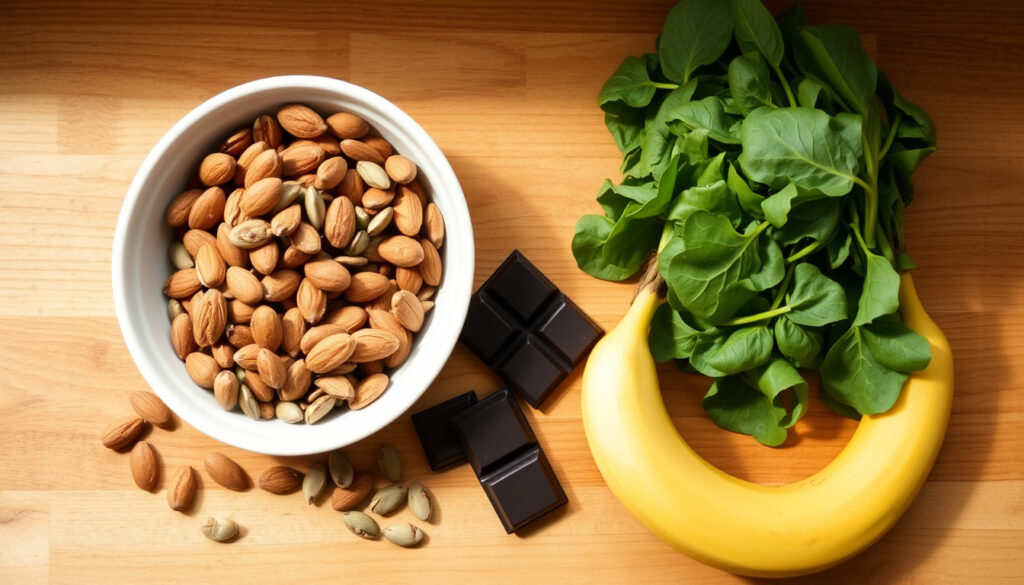
What Foods Have Magnesium? Top Sources & Daily Guide
Magnesium works behind the scenes in hundreds of chemical reactions, yet many adults don’t hit their daily target. The good news is that a varied diet full of seeds, greens, nuts, and legumes can easily fill the gap, and here’s what the evidence says about the foods that deliver the most magnesium, the myths to watch out for, and how to spot a shortfall.
Adult recommended daily intake: 310–420 mg (NIH ODS) ·
Pumpkin seeds (1 oz): 168 mg (Healthline) ·
Almonds (100 g): 270 mg (BBC Good Food) ·
Banana (medium): 32 mg (NIH ODS) ·
U.S. adults meeting needs: < 50% (NIH ODS)
Quick snapshot
- Pumpkin seeds: 168 mg per 1 oz (Healthline)
- Chia seeds: 335 mg per 100g (BBC Good Food)
- Sesame seeds: 126 mg per 1 oz (NIH ODS)
- Almonds: 270 mg per 100g (BBC Good Food)
- Cashews: 260 mg per 100g (NIH ODS)
- Walnuts: 158 mg per 100g (Healthline)
- Spinach (cooked): 157 mg per cup (NIH ODS)
- Kale: 30 mg per cup raw (NIH ODS)
- Swiss chard: 150 mg per cup cooked (Healthline)
- Black beans: 60 mg per ½ cup cooked (NIH ODS)
- Edamame: 50 mg per ½ cup (Healthline)
- Lentils: 36 mg per ½ cup (NIH ODS)
Six facts, one pattern: the richest magnesium sources are seeds and nuts, but a single food alone rarely covers the full daily target. Here’s how the numbers stack up across common reference points.
| Fact | Value |
|---|---|
| Highest magnesium food per 100g | Chia seeds – 335 mg (USDA via BBC Good Food) |
| Daily value (400 mg) in one food | No single whole food provides 100%; combination required (NIH ODS) |
| Banana magnesium content | 32 mg per medium banana (Healthline) |
| Egg magnesium content | 6 mg per large egg (USDA via NIH ODS) |
| Adult RDA (men) | 400–420 mg (NIH ODS) |
| Adult RDA (women) | 310–320 mg (NIH ODS) |
Which food is highest in magnesium?
Leafy greens and seeds
- Cooked spinach: 157 mg per cup (NIH ODS)
- Pumpkin seeds: 168 mg per 1 oz (about 37% of the daily value) (Healthline)
- Chia seeds: 335 mg per 100g – the highest per-gram density among common foods (BBC Good Food)
- Kale: 30 mg per cup raw (NIH ODS)
- Swiss chard: 150 mg per cup cooked (Healthline)
Green leafy vegetables are the classic magnesium source, but seeds actually beat them in raw density. The NIH Office of Dietary Supplements (the U.S. government’s lead nutrient authority) lists spinach and Swiss chard as top vegetable sources, yet pumpkin seeds deliver roughly the same amount in a handful.
Nuts and legumes
- Almonds: 270 mg per 100g (BBC Good Food)
- Cashews: 260 mg per 100g (NIH ODS)
- Walnuts: 158 mg per 100g (Healthline)
- Black beans: 60 mg per ½ cup cooked (NIH ODS)
- Lentils: 36 mg per ½ cup cooked (NIH ODS)
The advantage of nuts and legumes is portion flexibility. A quarter-cup of almonds provides roughly 95 mg, covering about a quarter of an adult woman’s daily needs. Legumes are lower per gram but contribute fiber and protein.
Anyone trying to maximize magnesium per calorie should reach for pumpkin seeds or chia seeds first. For volume eaters, cooked spinach and Swiss chard deliver nearly as much per serving with fewer calories than nuts.
Bottom line: Chia seeds lead the density race at 335 mg per 100g, but no single food covers 100% of the daily value. Combining seeds, nuts, greens, and legumes is the most effective strategy.
The implication: for maximum magnesium per bite, seeds and greens lead the pack.
What are signs of low magnesium?
Early symptoms
- Muscle cramps and twitches (healthdirect Australia – Australian government health service)
- Fatigue and weakness (healthdirect Australia)
- Numbness or tingling (healthdirect Australia)
- Loss of appetite, nausea (NIH ODS)
These signs are non‑specific – they could point to many deficiencies – but when a person eats a low‑magnesium diet for months, they become more suggestive. The Australian government’s healthdirect service notes that a blood or urine test is the only reliable way to confirm low status.
When to see a doctor
- Persistent muscle cramps or weakness that don’t resolve with rest or hydration
- Abnormal heart rhythms or palpitations – severe deficiency can affect the heart’s electrical conduction (NIH ODS)
- Seizures (rare, associated with critically low levels) (NIH ODS)
“Magnesium deficiency is often overlooked because the early symptoms are mild and can be mistaken for stress or overwork.”
– NIH Office of Dietary Supplements (U.S. federal nutrient authority)
The implication: don’t rely on symptom‑spotting alone. A simple blood test from your primary care provider is the clearest way to know.
Are bananas high in magnesium?
Magnesium content in bananas
- One medium banana (about 100–120 g): 32 mg magnesium (Healthline)
- That’s roughly 8% of the 400 mg daily value for adults (NIH ODS)
Bananas are often marketed as a good magnesium source, but 32 mg is modest. A single banana provides less magnesium than a quarter‑cup of almonds (95 mg), a tablespoon of pumpkin seeds (56 mg), or a cup of cooked spinach (157 mg).
Better fruit sources
- Avocado (one medium): 58 mg (NIH ODS)
- Figs (dried, ½ cup): 50 mg (Healthline)
- Blackberries (1 cup): 29 mg – similar to banana but with more fiber and less sugar
The pattern: bananas are convenient and contain potassium, but they lag far behind seeds, nuts, and greens for magnesium. Eating a banana daily won’t hurt, but it shouldn’t be your main magnesium strategy.
Bananas are a fine snack, but expecting them to meet magnesium needs is like relying on a drizzle for a full drink. Swap one banana for a handful of almonds and you triple the magnesium intake.
The pattern: bananas are convenient but not dense; combine them with seeds or nuts for a meaningful magnesium boost.
Are eggs high in magnesium?
- One large egg (50 g): ~6 mg magnesium (USDA via NIH ODS)
- That’s about 1.5% of the daily value
Eggs are a nutritious protein source, but they are not a meaningful magnesium contributor. Two eggs give roughly the same magnesium as a single Brazil nut (8 mg). For anyone relying on eggs as a primary magnesium source, the shortfall is substantial.
What drink increases magnesium?
Fortified beverages
- Fortified soy milk: ~61 mg per cup (NIH ODS)
- Some fortified breakfast drinks and protein shakes add 30–100 mg per serving; check labels
Fortification adds magnesium that isn’t naturally present, making soy milk a practical option for those who avoid dairy or need a quick morning boost.
Natural options
- Coconut water: ~15 mg per cup (Healthline)
- Mineral waters – some brands naturally contain 10–50 mg per liter, but levels vary widely by source (NIH ODS)
The NHS (the UK’s national health body) also notes that wholemeal bread and brown rice provide magnesium, though they aren’t beverages. For a drink that meaningfully contributes to your daily target, fortified soy milk is the standout choice.
How to get 100% daily magnesium from food?
Sample meal plan
- Breakfast: 1 cup fortified soy milk (61 mg) + 1 oz pumpkin seeds (168 mg) = 229 mg
- Lunch: 1 cup cooked spinach (157 mg) + ¼ cup almonds (95 mg) = 252 mg
- Snack/dinner: ½ cup black beans (60 mg) + 1 oz dark chocolate (64 mg) = 124 mg
Total: well over 600 mg – comfortably above the 310–420 mg RDA for adults. The key is combining sources across meals rather than expecting one food to carry the load.
Combining sources
- Seeds + greens: pumpkin seeds on a spinach salad
- Nuts + legumes: almond butter on lentil soup
- Whole grains + beans: brown rice with black beans
The Hull University Teaching Hospitals NHS Trust (UK hospital authority) recommends including a variety of legumes, nuts, seeds, leafy greens, and whole grains to meet magnesium needs without supplements.
“Most people can get enough magnesium by eating a varied diet that includes plenty of green vegetables, nuts, seeds, and whole grains.”
– healthdirect Australia (Australian government health advisory)
The catch: no single food does it; combination is the only reliable strategy.
What’s unclear
- Bioavailability of magnesium from different plant foods relative to animal sources
- Exact magnesium content of some mineral waters varies by brand
- The effect of cooking on magnesium retention is not precisely quantified
- The percentage of magnesium absorbed from different food sources is not well established
For anyone relying on a limited diet, the risk of low magnesium is real: without intentional choices, you’ll likely fall short. The actionable step is to build meals around seeds, nuts, greens, legumes, and fortified options. For the average adult, that approach removes the guesswork – and the need for supplements.
Related reading: Pizza Sauce Recipe NZ · 200 Pounds in kg
medlineplus.gov, efsa.onlinelibrary.wiley.com, pressbooks.oer.hawaii.edu, lnds.nhs.uk, efsa.europa.eu, nhslanarkshire.scot.nhs.uk, efsa.europa.eu, ods.od.nih.gov
Frequently asked questions
Do walnuts have magnesium?
Yes – 158 mg per 100g (about 16 walnut halves). They are a good source, though lower than almonds or cashews per gram (Healthline).
How much magnesium per day for seniors?
Adults over 70 need slightly more: 420 mg for men, 320 mg for women, per NIH ODS.
Can you get too much magnesium from food?
It’s very rare – the body excretes excess from food. Toxicity almost always comes from supplements (NIH ODS).
What fruits are highest in magnesium?
Avocado (58 mg each), dried figs (50 mg per ½ cup), and blackberries (29 mg per cup). Bananas are lower than most people assume.
Is dark chocolate a good magnesium source?
Yes – 1 oz (28g) of 70–85% cocoa provides about 64 mg, or 16% DV (NIH ODS).
How does cooking affect magnesium levels in foods?
Boiling can leach magnesium into cooking water; steaming or roasting retains more. Using cooking water (soups, stews) recovers the lost minerals.
What this means: diet diversity removes the guesswork.
More related posts
 Jet Ski Incident Port Waikato: Tragic Christmas Day
 Power Outage Today Near Me: Check, Report & Stay Safe
 First Aid Course Christchurch: Costs & Providers (2025)
 Black Shoes for Women: Style, Comfort & Trends
 Health and Wellbeing Level 3: Qualifications & Equivalents
 1 Gallon to Litres: US vs UK Explained
 Truth or Dare Questions:300+ Truths & Dares for Friends & Couples